
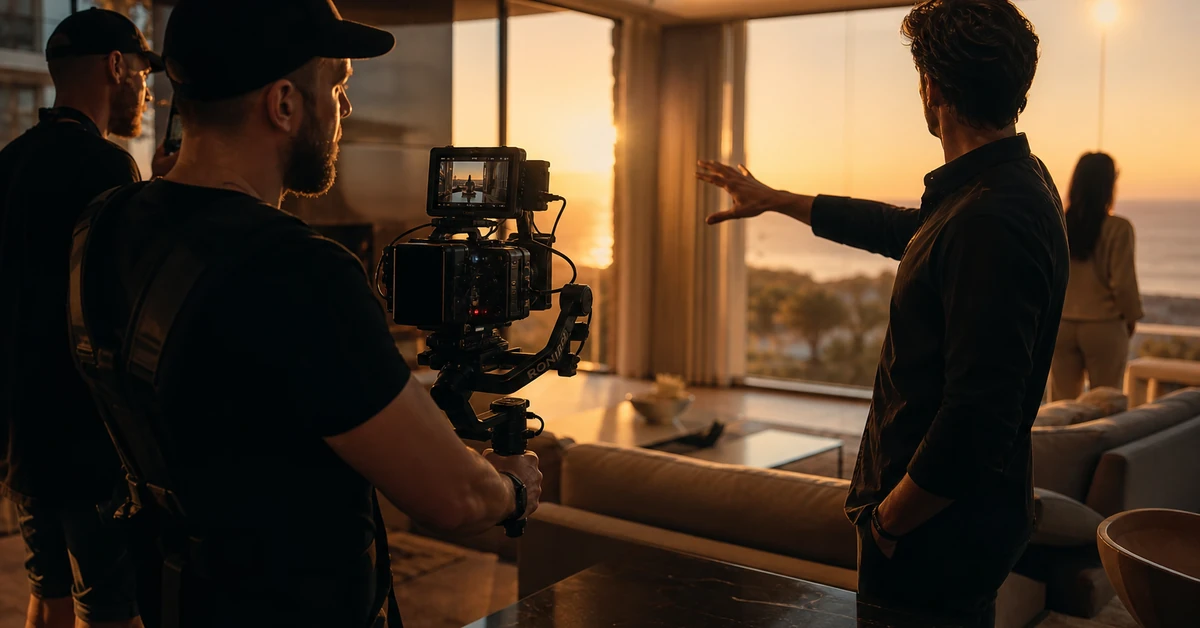
If you’re selling a property without video, you’re leaving something real on the table — 403% more inquiries, to be precise. That’s the data-backed gap between listings that sit and listings that move. Professional real estate video production isn’t a luxury add-on anymore. It’s the primary channel through which buyers decide what to see, what to share, and what to bid on. And yet only about 38% of agents use video at all — meaning the window is wide open for agents, developers, and brands willing to make the investment.
That gap? It’s the whole game. Here’s how professional real estate video production closes it.
Why Real Estate Video Production Is the Highest-ROI Dollar You’ll Spend on a Listing
Let’s skip the soft pitch and go straight to the numbers. Listings with video attract 403% more inquiries than photo-only listings, according to data cited by Amplifiles and the National Association of Realtors. Not 10% more. Not double. Four hundred and three percent.
73% of homeowners say they’re more likely to list with an agent who uses video marketing. Buyers are making filtering decisions before they ever set foot in a property — and the video is what gets them through the door. Or keeps them scrolling past.
Video is where the buyer’s attention lives. Viewers retain 95% of a message watched on video versus 10% when reading it in text, per Wyzowl’s 2025 State of Video Marketing. And video marketers generate 66% more qualified leads per year. These aren’t vanity metrics. They’re the difference between a listing that lingers and one that generates competitive offers in the first weekend.
For commercial properties, developers, and luxury residential, the math gets even sharper. Homes marketed with video sell for roughly 6% more. Properties with drone or aerial footage sell up to 68% faster. Virtual tours cut time-on-market by about 31%. These are compound gains — shorter listing cycles, higher selling prices, and a reputation that compounds with every deal.
The Attention Problem Most Agent Videos Can’t Solve
Here’s the uncomfortable truth. Most agent-shot video doesn’t look professional — and buyers can tell in the first two seconds. Shaky handheld footage, bad audio, blown-out windows, and the agent’s voice echoing through an empty room. That’s not video marketing. That’s documentation.
The platforms have raised the bar. Instagram Reels, TikTok, YouTube Shorts — buyers scroll past amateur content without a second thought. Professional real estate video production means color-graded footage, stabilized camera movement, intentional lighting, and a narrative arc that holds attention. It means the property looks the way it actually feels to stand in the best room in the house. That’s what sells.
A full-service production team — the kind that handles concept through delivery — doesn’t just point a camera and hit record. They plan the sequence. They know which rooms to open with and which to save for the closer. They understand that the best real estate video production doesn’t produce a tour. It produces a story with the property as the main character.
The Three Types of Real Estate Video That Drive Measurable Results
Not all real estate video production serves the same purpose. Mixing up the formats costs you attention and money. Here are the three types that actually move the needle — and what each one is built to do.
1. The Cinematic Property Walkthrough
This is the flagship. A three-to-five-minute guided tour shot on stabilized gimbals with intentional lighting, smooth pacing, and a score that matches the property’s energy. The best walkthroughs don’t show every room in order — they open on the hero space (the kitchen, the view, the great room), establish the lifestyle, then pull back into the details. Buyers make emotional decisions in the first 15 seconds. The walkthrough’s job is to make that decision impossible to walk away from.
These are the videos that agents embed on the MLS, share in listing emails, and pin to the top of their Instagram grid. Done right, they work across every platform — which is what separates a professional production from a point-and-shoot effort.
2. The Neighborhood Context Piece
A property doesn’t exist in a vacuum. The neighborhood sells the lifestyle — walkability, schools, the coffee shop two blocks over, the park where people walk their dogs at sunset. A neighborhood context video weaves drone aerials of the surrounding area with ground-level footage of local landmarks, street scenes, and community touchpoints. It answers the question buyers are actually asking: What does my life look like if I live here?
These pieces are especially effective for new developments, relocation buyers, and luxury properties where the setting is part of the value proposition. They also double as content for the developer’s or agent’s overall brand — not just the individual listing.
3. Agent and Developer Brand Video
This is the asset that outlasts any single listing. A well-produced brand video introduces you — your philosophy, your track record, the way you work — in under 90 seconds. It lives on your homepage, your YouTube channel, and your social profiles. It’s what buyers see before they see the property. And according to Inman’s 2026 real estate video content guide, agent-led video content is the single biggest conversion driver in the current market because it builds trust before the buyer ever fills out a contact form.
At Pretzel Logic Productions, we’ve seen this play out across dozens of productions. The clients who invest in brand video alongside their listing videos don’t just sell faster. They build recognition that compounds — each piece strengthens the next. It’s the difference between marketing a single property and marketing yourself as the obvious choice.
Planning for Success: The Pre-Production Framework That Separates Amateur from Pro
Great real estate video production doesn’t start with a camera. It starts with a plan. The productions that deliver results — the ones that get shared, replayed, and linked to offers — all share the same pre-production discipline. Skip it, and you’re gambling with time and budget.
The Shot List Is Your Production’s Operating System
Walking into a property without a shot list is the fastest way to burn half a day and walk out with footage that doesn’t cut together. A professional shot list for real estate video production includes: the opening hero shot (what sells the property in the first three seconds), the room sequence (what order tells the best story, not the floor plan order), transition shots (slider moves through doorways, gimbal reveals around corners), detail inserts (fixtures, textures, sunlight patterns), drone beats (roofline to horizon, neighborhood context, property-in-setting), and the closing shot (what leaves the viewer wanting to schedule a showing).
Every shot on that list has a job. If it doesn’t advance the story or reveal something meaningful about the property, it gets cut before filming starts. That discipline — knowing what not to shoot — is what distinguishes pro-level video from a long tour.
Staging for the Lens, Not the Eye
The camera sees differently than a person walking through a room. Reflections in glass, color temperature mismatches between interior and exterior light, cluttered sightlines — all of these register on video in ways they don’t in person. Professional staging for video production means walking the property with the DP before any gear comes out. Windows get treatments. Lamps get positioned for fill light. Reflective surfaces get flagged or angled. Countertops get cleared. It’s detail work, but the difference between a space that looks lived-in and one that looks messy often comes down to three minutes of pre-shoot adjustment.
One more thing: sound. Empty rooms echo. HVAC systems hum. Street noise leaks through windows. A professional production either controls these or works around them — because bad audio makes even the best-looking footage feel amateur.
Gear, Lighting, and Drone Work: What Professional Real Estate Video Production Actually Requires
You don’t need a Hollywood budget, but you do need the right tools — and more importantly, the right people operating them. Here’s what goes into a production that competes at the level buyers expect.
Camera and Stabilization
Modern mirrorless cameras — Sony FX series, Canon C-series, Blackmagic — paired with motorized gimbals are the professional standard. The gimbal is non-negotiable. Handheld footage in real estate reads as shaky and rushed. A gimbal gives you the floating, cinematic movement that makes a property feel expansive. Sliders add another layer — slow horizontal reveals through doorways that create a sense of entering a space, not just looking at it.
Lighting for Interiors
Natural light is the foundation, but it’s not reliable. A partly cloudy day creates exposure shifts mid-shot. Bright windows behind dark interiors create contrast the camera can’t hold. Professional crews bring portable LED panels, bounce cards, and diffusion to balance interior and exterior light. The goal isn’t to make the room look lit — it’s to make it look like the light is coming from nowhere. Just the room, looking exactly right.
Drone and Aerial Work
Drone footage is now a buyer expectation, not a bonus. Properties with aerial video sell up to 68% faster, per SofaBrain’s 2026 real estate video marketing data. The shots that work best: establishing the property in its setting, revealing acreage and boundaries, capturing proximity to water, parks, or city skylines, and dramatic pull-back reveals from roof-level. In the U.S., commercial drone operation requires FAA Part 107 certification — another reason to hire a production company rather than DIY.
A complete guide to real estate video production equipment and shot planning — covering camera settings, lens choices, gimbal techniques, and drone recommendations — is available from Tips for Real Estate Photography. But knowing the gear list isn’t the same as knowing how to use it under pressure, on location, with a client watching. That’s where experience earns its cost.
Post-Production, Distribution, and Measuring What Actually Matters
The shoot wraps. Now the work that separates a good video from a great one begins. Post-production is where raw footage becomes an asset — and where most agent-shot video falls apart.
The Editing Decisions That Make or Break a Property Video
Color grading is where good real estate video production separates from amateur work. Interiors shot under mixed lighting — warm lamps, cool window light, overhead fluorescents — need to be balanced so the white walls look white and the hardwood reads true. A flat, ungraded real estate video screams amateur. The grade gives it cinematic polish.
Pacing is the invisible art. Too slow, and the viewer bails. Too fast, and the property feels like a blur. The sweet spot for a property walkthrough is 2:30 to 4:00 minutes — enough time to establish the lifestyle, tour the key rooms, and land the close. Each shot gets 3–6 seconds unless it’s a hero moment (the kitchen reveal, the view, the primary suite).
Sound design matters more than most producers admit. A music track that matches the property’s energy. Natural room tone blended underneath. Maybe a voiceover that guides without overselling. The combination is subtle, but its absence is immediately noticeable.
Distribution: The Step Most Production Teams Skip
A beautiful video no one sees is an expensive paperweight. Distribution planning should begin before the shoot — not after the export. The most effective approaches for 2026, as outlined by AutoReel’s real estate video marketing playbook, emphasize short-form vertical cuts (9:16) for Reels, TikTok, and Shorts alongside the full horizontal version for YouTube and MLS. The vertical cuts aren’t an afterthought — they’re the primary discovery engine. A full walkthrough gets your listing seen by people already searching for it. A 30-second vertical reel gets it in front of people who didn’t know they wanted it.
SEO matters here too. Video listings attract 157% more organic search traffic than text-only listing pages. Title your video file with the property address and keywords. Write a description that front-loads the most important features. Tag it with the city, neighborhood, and property type. These aren’t advanced tactics — they’re table stakes that most agents skip.
For agents and developers working with a full-service agency like InnoVision Marketing Group, distribution becomes part of an integrated campaign — brand videos, listing walkthroughs, and social cuts all pushing toward the same conversion goal. Production without distribution is half the equation. The teams that win are the ones that plan both from the start.
Measuring What Worked
Views are a vanity metric. What matters: inquiries per listing, days on market, offer-to-list-price ratio, and repeat client rate. Track these before and after adding professional video. The data will tell you exactly what the investment is returning. And if you’re working with Pretzel Logic Productions, we’ll help you connect those dots — because a production partner should care about outcomes, not just deliverables.
Frequently Asked Questions
How much does professional real estate video production cost?
Costs range from $1,500 to $8,000+ per property depending on the scope — a single walkthrough runs lower, while a full package with drone aerials, neighborhood context footage, and multiple edited cuts runs higher. The investment typically pays for itself through faster sales and higher offers. Production companies that offer tiered packages let you match the budget to the property’s price point.
What’s the difference between a video walkthrough and a virtual tour?
A video walkthrough is a curated cinematic experience — professionally shot, edited, and scored — that guides the viewer through the property’s best features with intentional pacing and emotional impact. A virtual tour is an interactive 360-degree tool the viewer controls. The two formats serve different stages of the buyer journey: video captures attention and builds desire; virtual tours satisfy the buyer who’s already interested and wants to explore details independently.
How long should a real estate listing video be?
The sweet spot is 2 to 4 minutes for a full property walkthrough, 30 to 60 seconds for social media cuts, and 60 to 90 seconds for YouTube. Attention drops sharply after 4 minutes on a listing video. The first 3 seconds need a hook — dramatic aerial, hero room reveal, or a question that makes the viewer want the answer.
Do I need a drone for real estate video production?
For most properties above a certain price point, yes — drone footage has become a buyer expectation, not a bonus. Aerial shots establish the property’s setting, reveal acreage, capture proximity to desirable landmarks, and create the kind of dramatic opening that stops a scroll. Properties with drone video sell up to 68% faster. Commercial drone operation requires FAA Part 107 certification, so hire a licensed operator or a production company that includes aerial work.
Can I shoot real estate video with my phone?
Smartphone cameras have come a long way, but they’re still limited by sensor size, stabilization, and audio quality — all of which matter more in real estate video than most people realize. A phone on a gimbal with good natural light can produce acceptable social media cuts for lower-budget listings. For luxury properties, commercial developments, or brand-building content, professional gear and an experienced crew produce results a phone cannot match. The question isn’t just image quality — it’s lighting, audio, shot planning, and post-production polish.
What’s the best platform to share real estate videos?
YouTube for the full walkthrough (SEO value is significant — video listings attract 157% more organic search traffic). Instagram Reels, TikTok, and YouTube Shorts for discovery-driven vertical cuts. The MLS for the primary listing embed. Email for direct-to-buyer distribution. And the agent’s or developer’s own website for brand videos. A distribution strategy spreads one production across all channels — not one video on one platform.
The Bottom Line
The data is clear. Properties with professional video get more inquiries, sell faster, and command higher prices. But the real advantage isn’t any single stat — it’s the compound effect. Each video builds the next. Each listing that moves fast builds your reputation. Each buyer who shares a walkthrough becomes free distribution.
The 38% of agents already using video aren’t just ahead. They’re building a moat. Every listing they publish with professional production widens the gap between their brand and everyone else’s. The question isn’t whether real estate video production works. The question is how long you’re willing to let your competitors have that gap to themselves.
Ready to see what professional video production can do for your listings? Explore our portfolio of commercial and brand video work, or get in touch to talk about your next property. At Pretzel Logic Productions, we bring big-budget production quality to projects of any scope — with a twist.