
Ask anyone “how much does video production cost” and you’ll get the same range: somewhere between $800 and north of $100,000. It’s the honest answer — but it’s not a helpful one. If you’re budgeting for a real project, you need to know what drives the number, where your money actually goes, and what trade-offs are worth making. Because the decisions you make before a single frame is shot determine everything that follows. And the range narrows considerably once you understand what you’re actually shopping for.
The Real Numbers Behind How Much Does Video Production Cost in 2026
Per-minute pricing is the closest thing to a universal yardstick. Full-service production companies average about $1,000 per finished minute. Remote teams come in at $250 to $500 per minute. But per-minute math has limits. A 60-second spot with visual effects, multiple locations, and a full crew doesn’t cost the same as two 30-second talking-head edits — the creative variables multiply faster than the runtime.
The global video production market tells the bigger story. Valued at $45.6 billion in 2023 and projected to reach $72.5 billion by 2030 — growing at 7.9% annually — this isn’t a Hollywood phenomenon. It’s businesses of every size discovering that video is no longer optional. 91% of businesses use video as a marketing tool now. They’re producing social content, brand films, customer testimonials, and explainer videos. The question “how much does video production cost” is being asked in more boardrooms and marketing meetings than ever before, and the answer keeps shifting as production technology evolves and audience expectations rise. They’re producing social content, brand films, customer testimonials, and explainer videos. The question “how much does video production cost” is being asked in more boardrooms and marketing meetings than ever before.
What’s striking about the spending data is how it’s distributed. Wistia’s research across 100,000+ businesses reveals that only about one-third of companies spend $5,000 or more per year on video production. Two-thirds are producing video below that threshold — getting creative with smaller budgets, leaner crews, and smarter planning. At the same time, 40% of teams plan to increase their video spend this year, even if that’s down from the 57% who said the same thing in 2023. The industry is maturing. Budgets are getting smarter, not just bigger.
This is where Pretzel Logic Productions has carved its sweet spot. Big-budget production quality doesn’t demand a big-budget price tag — it demands a production partner who knows how to allocate resources where they count. That skill was built over a decade of work across casino campaigns, healthcare brand films, restaurant commercials, and everything between. When someone asks “how much does video production cost,” the real question underneath is usually “can I afford the quality I actually need” — and the answer is yes more often than most businesses realize.
What Drives Video Production Pricing: The Cost Factors That Matter
Video production costs follow a logic that, once you understand it, turns every quote you receive into something you can evaluate with confidence. Industry data from Clutch and AICP surveys breaks this into eight core factors. Three of them dominate the math for nearly every project.
Crew Size and Talent Level
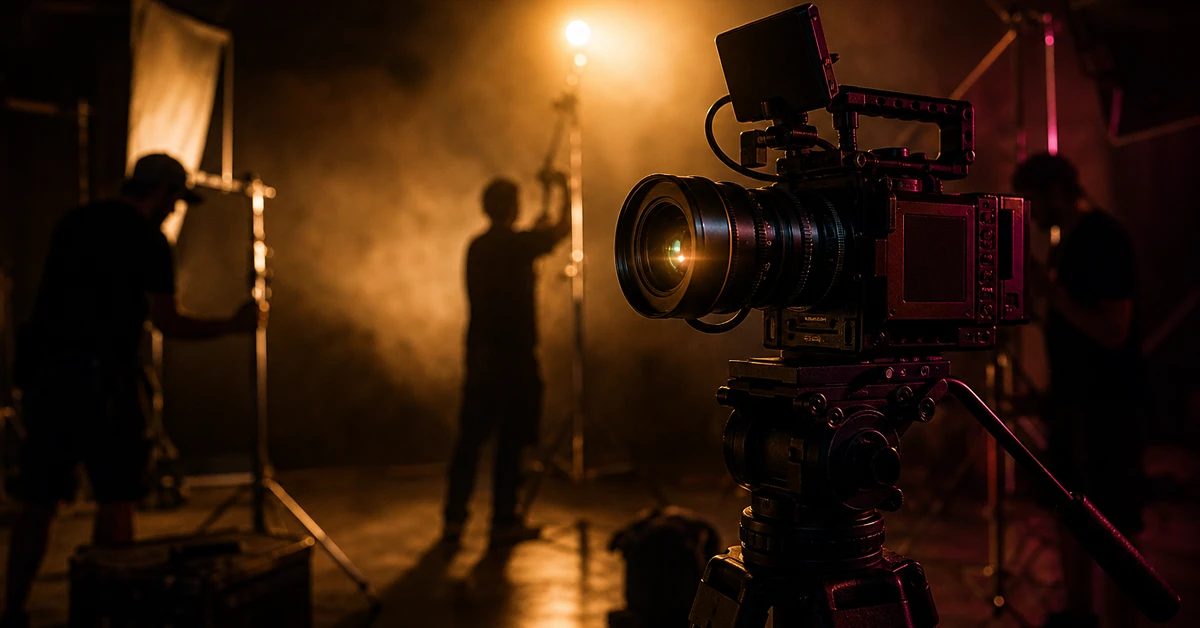
A solo shooter with a mirrorless camera and a basic lighting kit costs $500 to $1,500 per day. Scale up to a full crew — director, DP, camera operator, gaffer, sound engineer, producer — and the day rate jumps to $5,000 to $15,000. The difference shows up in every frame. More hands mean more angles covered, cleaner audio captured, fewer compromises made under time pressure.
But you don’t always need the full battalion. A lean, skilled three-person crew can deliver broadcast-quality footage when they move efficiently and make smart creative decisions in real time. The question isn’t “how big should my crew be” — it’s “what does this specific project actually need.” Matching crew scale to creative ambition, rather than defaulting to the largest team the budget permits, is where cost efficiency lives. If you’re asking “how much does video production cost” with a specific number in mind, this is the single biggest lever you can pull.
Pre-Production: The Phase Where Money Gets Protected
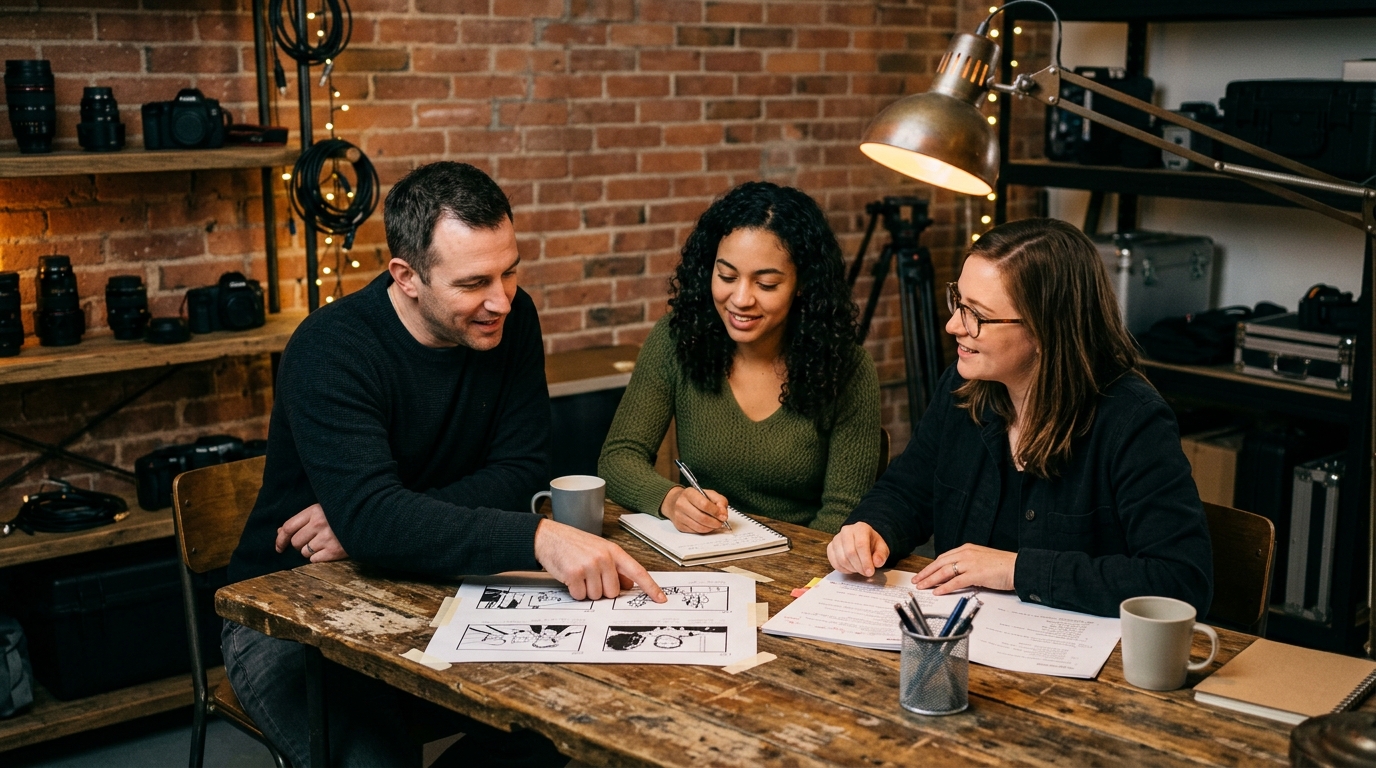
Pre-production accounts for 15% to 25% of total project cost — and it’s where the smartest dollars get spent. A single day refining a script prevents three days of patching things together in the edit bay. A properly scouted location eliminates surprise permit fees and equipment rentals you didn’t plan for. This is also where “how much does video production cost” stops being a vague question and starts being a real budget — because pre-production is where scope gets defined, and scope is what determines cost.
At Pretzel Logic Productions, the full production process starts with concept development, scripting, and storyboarding before any camera is powered on. That upfront investment is the single most reliable predictor of a production that stays on time and on budget. Skip it and you’ll pay — usually in overtime charges at hour 11 of a shoot day that should have wrapped at hour eight.
Post-Production: The Silent Budget Eater
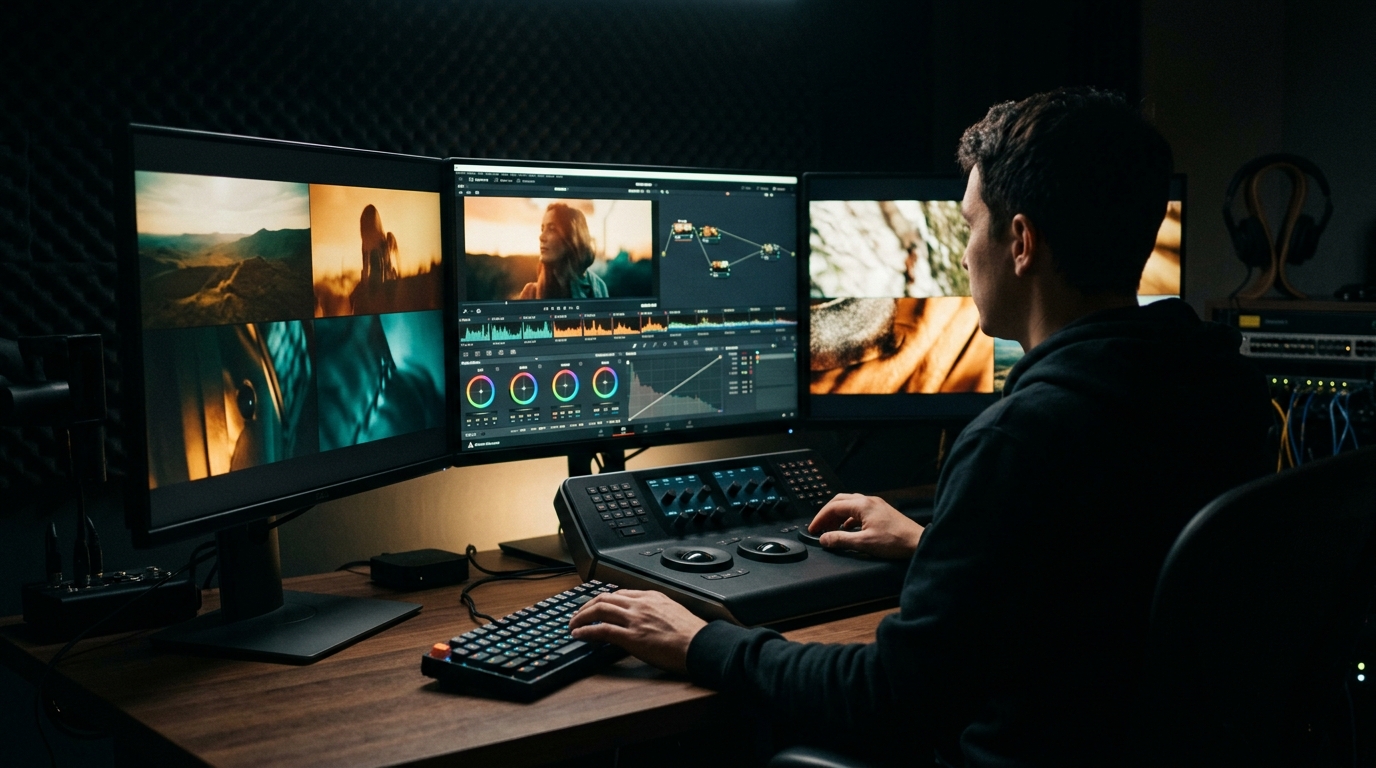
Post-production is where first-time clients get surprised. It accounts for 30% to 50% of total project cost, and you can’t watch it happen. Cameras and lights are visible on set. Color grading, sound design, and motion graphics feel invisible until they’re finished — and then they feel like magic, not labor.
Editing runs $75 to $150 per hour for a skilled professional. Color grading adds another layer. Sound mixing — often the single element that separates amateur video from cinematic production — adds yet another. Rush delivery fees can tack 25% to 50% onto the post-production bill when a finished cut is needed fast.
When you’re evaluating a quote, look carefully at what post-production is included. A lower upfront shooting cost that quietly omits color grading or sound design isn’t cheaper — it’s a partial estimate. Full-service post-production bundled into the project fee — editing, color, sound, and motion graphics under one roof — is how you avoid the death-by-line-item experience. It’s also where “how much does video production cost” gets its most honest answer, because the number you hear includes everything the final product needs.
What Different Types of Videos Actually Cost
Strip away the variables and look at what real businesses pay, and a clear picture emerges. Clutch surveyed 1,200 video production agencies and found consistent pricing bands that match what production teams see in the field every day.
Social media content. Short-form clips for Instagram, TikTok, and LinkedIn land between $500 and $8,000. The low end buys a clean single-take piece with light editing. The high end delivers multi-location shoots with custom graphics, licensed music, and platform-specific cutdowns. Volume changes the math — producing a batch of social clips in a single shoot day drives per-unit costs way down and answers “how much does video production cost” with a number that scales in your favor.
Explainer and brand videos. The animated or live-action pieces that sit on your homepage range from $3,000 to $35,000. Animation style drives most of the spread. A clean 2D explainer with voiceover costs dramatically less than a custom-illustrated piece with character rigging and original sound design. The animation approach should follow the brand strategy, not the other way around.
Corporate brand films. The B2B workhorse format runs $10,000 to $75,000. These projects typically span multiple shoot days, involve real employees or hired talent, and need polished post-production with brand-consistent color grading. They’re the videos that anchor a company’s About page or open a sales presentation — and they need to project competence in every frame.
TV commercials. The widest band in the industry. Local and regional spots sit at $5,000 to $50,000. National broadcast commercials, with union talent, multiple locations, and weeks of post, cross $50,000 and routinely reach $500,000 or more. The production standards are higher because the distribution demands it — broadcast-safe color grading, closed-caption compliance, and network audio specifications all add cost.
As DesignRush documented in their 2026 cost analysis, the same video format can cost 5x to 10x more depending on who produces it and where. A corporate brand film shot by a boutique team in a secondary market costs dramatically less than the same brief handled by a major-market agency — even though both deliverables can look identical on screen. The upshot for anyone asking “how much does video production cost” is simple: format sets the floor, but your production partner sets the ceiling.
In-House vs. Agency: The True Production Cost Comparison
The in-house-versus-agency math is shifting rapidly. According to Wistia’s comprehensive industry data, 71% of companies now produce video in-house, up from 63% just two years ago and 46% in 2020. A full-time videographer costs roughly $90,000 annually in salary and benefits. Add equipment, software licenses, and workspace and the real burn approaches $120,000 per year.
That’s excellent production capacity if you’re generating weekly content. It’s a terrible deal if you need two polished commercials per year. The agency path — hiring a production partner per project — gives access to specialized talent without carrying headcount. You pay more per minute produced. You only pay when you need to produce something.
The AI dimension is reshaping the bottom end of this equation. Forty-one percent of video professionals now use AI in their workflow — more than double the 18% from the prior year, a shift that is fundamentally reshaping post-production economics. AI tools compress editing timelines, generate rough-cut assemblies from raw footage, and handle transcription and subtitling that used to chew up billable hours. For budget-conscious productions, this unlocks a middle ground between bare-bones DIY and full-service agency — where AI handles the heavy lifting on repetitive post tasks while human editors focus on the creative decisions that actually show up on screen. The cost floor is dropping for template-driven social content. The ceiling for premium work — on-location shoots with talent direction and creative vision — hasn’t moved.
For productions that demand a dedicated studio — green screen shoots, multi-camera interview setups, tabletop product work — facilities like Lightz Out Studios in San Diego provide the infrastructure without the real estate overhead. Rent the space, bring your creative team, and keep costs anchored to project scope rather than square footage.
How to Budget for Video Production Without Guesswork
Budgeting for video production doesn’t require throwing darts at a spreadsheet. It requires asking the right questions in the right order.
Start with distribution, not production. A broadcast TV spot, a homepage hero video, a paid social campaign, and an internal training video all demand different production values. The distribution channel sets the quality floor. The quality floor sets the budget. Answer this first and everything else follows naturally.
Lock the creative brief before locking any numbers. Most budget overruns happen because the brief evolves mid-production — a script changed after location scouting, animation added after the shoot. Each pivot compounds costs non-linearly. Define exactly what you’re making upfront. The process is tedious. It’s also where budgets get protected.
Allocate by production phase. A sensible split: 20% pre-production, 40% principal photography, 40% post. Within post, earmark at least half for editing and the remainder for color grading, sound design, and motion graphics. When a studio bundles post into the project fee, clarify what’s included so nothing surfaces as a surprise after wrap.
Build in a 15% contingency. Even the tightest productions hit something unexpected — a weather delay, a music licensing issue, a client revision that adds a day of editing. A cushion means a small hiccup stays small.
Evaluate ROI, not just line items. 89% of marketers say video delivers a strong return on investment and 87% say it directly helped increase sales, according to Wyzowl’s 2026 State of Video Marketing survey. That’s the answer to “how much does video production cost” that most pricing guides miss — it’s not about the number on the invoice, it’s about what the invoice produces. A $15,000 brand film that generates $200,000 in pipeline value isn’t expensive — it’s a bargain. The trap is evaluating video against a cost ledger without measuring what it produces. Track video-attributed conversions, leads, and engagement. It’s the only metric that justifies any budget. That’s the real answer to “how much does video production cost” — not a number, but a return calculation that makes the number make sense.
If you’re ready to move from asking “how much does video production cost” to exploring what professional production looks like for your brand, start the conversation with Pretzel Logic Productions. We’ll help you scope a project that matches creative ambition to a budget that works — no surprises, no fluff, just a straight path to a final product you’ll be proud of. Fresh, hot, and slightly twisted. That’s how we deliver every time.
Frequently Asked Questions About Video Production Pricing
What’s the cheapest way to get professional-quality video?
The most cost-effective path: a lean crew shoot with one skilled videographer and a producer handling logistics, in a single location with natural light. Skip multi-camera rigs and complex lighting setups unless your distribution channel demands them. You’ll get clean, competent footage at $1,500 to $5,000 per finished minute — professional results without the professional price tag.
How much should a small business budget for their first brand video?
Plan $5,000 to $15,000 for a quality 60-90 second brand video that includes basic pre-production, a half-day shoot, and professional post-production — color grading, sound mixing, and basic motion graphics. This range delivers a polished piece suitable for website hero placement, social media, and sales presentations. It’s the video that anchors your brand presence online.
Does video length directly affect production cost?
Less than most people assume. A 30-second spot and a 90-second brand film shot on the same day with the same crew cost nearly the same to produce. The shoot day is the shoot day. What drives cost is complexity per frame: number of locations, talent requirements, set design, and VFX shots. Maximize your shoot day rather than trying to shorten your runtime — it’s the more efficient play.
Why do TV commercials cost so much more than digital videos?
Broadcast commercials carry technical requirements digital content doesn’t: broadcast-safe color grading, closed-caption compliance, union talent rates, and audio mixed to network specifications. Add the creative stakes — a Super Bowl-adjacent spot has to hold its own against multi-million-dollar productions — and the bar rises with every dollar of airtime you’re buying.
Is stock footage a viable alternative to a custom shoot?
Stock footage costs $50 to $500 per clip versus thousands for a shoot day — so on paper, it’s dramatically cheaper. The trade-off is authenticity. Stock signals “generic” to viewers with increasingly sharp detectors. For social content where speed and volume matter, stock mixed with branded graphics works. For your flagship brand video or a commercial, original production justifies its cost through audience trust alone.
What cost factor surprises first-time clients the most?
Music licensing. A track licensed for web use costs $50 to $300. The same track licensed for broadcast can hit $2,000 or more. Subscription libraries like Artlist and Epidemic Sound cover most digital use cases, but broadcast rights are almost always a separate negotiation. Confirm music licensing terms during budgeting — it’s the easiest line item to overlook until the invoice arrives.
Ready to tell your story? If you’ve been asking “how much does video production cost” without a clear answer, it’s time to get one that’s specific to your brand. At Pretzel Logic Productions, we bring big-budget production quality to projects of every scope — with a creative process that’s transparent from concept to final cut. Let’s build something worth watching.