
Motion graphics animation has quietly become the visual language of modern business. Not the supporting act. The main event.
Brands used to ask whether they should include motion in their content. That question’s dead. The real one: how fast can you get it in front of an audience that scrolls past static images without a second glance? You have about two seconds. Motion buys you more.
What Is Motion Graphics Animation (and How Is It Different from Traditional Animation)?
Motion graphics are pieces of animation or digital footage that create the illusion of motion through graphic design elements — text, shapes, icons, and abstract visuals — usually paired with audio for use in multimedia projects. Think of it as graphic design that breathes. While character animation tells stories through lifelike figures with personalities and emotional arcs (Pixar films, cartoon series), motion graphics animation communicates ideas, data, and brand messages through the movement of graphic elements themselves.
The split isn’t always clean. Modern motion graphics has evolved from simple 2D layer-based animation into a discipline that blends design, 3D animation, compositing, and real-time effects within a single project. But the distinction matters for anyone hiring a production partner. Traditional character animation needs rigging, keyframing performances, and a deep understanding of acting and physics. Motion graphics animation needs typographic instinct, a feel for timing and rhythm, and the ability to translate abstract concepts into visual momentum. Different skills. Different timelines. Different budgets.
Adobe describes the technique as “graphics with movement” — an innovation that transformed graphic design when it emerged in the mid-20th century. What started as experimental film title sequences is now the backbone of brand identity across every screen your customers own. The tools have evolved from optical printers and film strips to real-time GPU-powered engines capable of rendering photorealistic 3D motion in milliseconds. A designer working in 2026 has more creative firepower on a laptop than a mid-size studio commanded fifteen years ago.
If you’re comparing motion graphics to full character animation for your next brand project, here’s the practical difference: motion graphics excels at explaining products, visualizing data, and building brand energy. Character animation excels at narrative and emotional connection. Most brands need both — but they need motion graphics first. A logo animation alone can establish brand polish in three seconds. A product explainer with motion graphics can replace five pages of a PDF. The format isn’t just decorative — it’s functional communication.
The Business Case: Why Motion Graphics Is a $25 Billion Industry
There is no “maybe” left in the data. The global motion graphics market hit $25.6 billion in 2022 and is climbing at 12.5% annually. The broader animation market reached $492 billion in 2026, with projections nearly doubling that to $953 billion within the next decade. Marketing animation alone — brand videos, explainers, social content — hit $1.02 billion in 2026 and is headed toward $3.57 billion by 2035 at nearly 15% annual growth.
The numbers are loud. The psychology behind them is louder.
Viewers retain 95% of a message delivered through video. Text gets you 10%. That’s not a small gap — it’s a canyon that separates brands who are seen from brands who are scrolled past. When the Collision Awards surveyed professionals in 2026, nearly 74% reported increased demand for animation and design work over the previous year. 95% agreed that social media is an essential distribution channel.
What’s driving the surge? Three things, mostly.
First, the platforms demand it. YouTube Shorts pulls 50 billion daily views. TikTok and Instagram Reels have conditioned audiences to expect motion within the first half-second of every piece of content they encounter. Static posts still work for some things. But motion graphics animation dominates the feed — and the algorithms are increasingly designed to keep it that way.
Second, brands have figured out the ROI. When 78% of companies plan to increase motion graphics budgets between 2024 and 2028, and 65% have already shifted to real-time rendering engines, you’re not looking at a trend. You’re looking at an infrastructure build-out. Companies aren’t experimenting with motion anymore. They’re staffing for it. The freelance motion design workforce alone has grown to over 450,000 globally — up 20% in 2023.
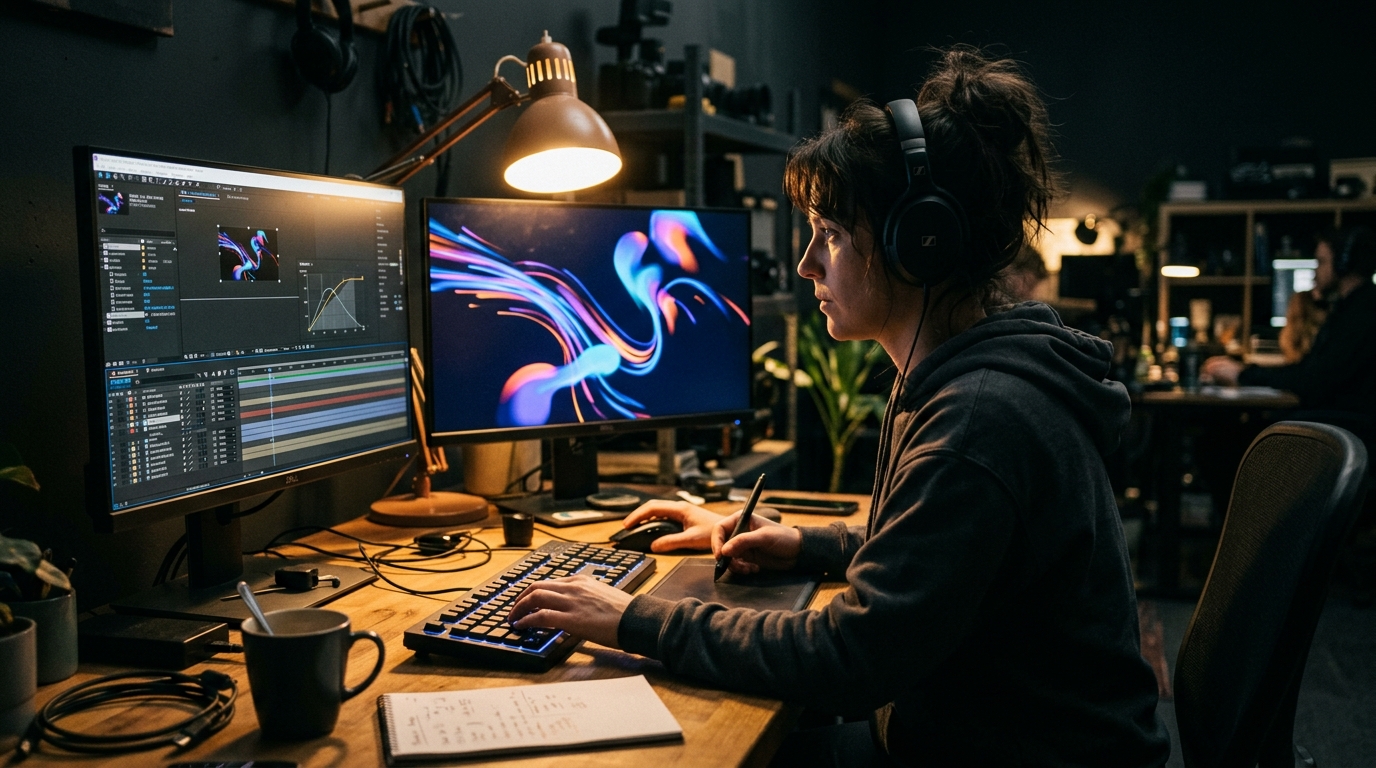
Third — and this one matters most for businesses evaluating a production partner — the cost-quality barrier has collapsed. After Effects, the industry standard used by over 80% of professional motion designers, costs about as much as a streaming subscription. Cinema 4D, used by 70% of pros for 3D motion work, integrates directly into After Effects. Add free tools like Blender and DaVinci Resolve to the mix and you have a toolkit that would have been financially out of reach for most small studios a decade ago.
The democratization of tools hasn’t killed demand for professional studios. It’s done the opposite. When every brand can access the software, the differentiator becomes taste, creative direction, and speed. The tools are available. The vision — and the team to execute it — is what you’re actually paying for.
Essential Tools and Software That Power Modern Motion Graphics
Motion graphics animation doesn’t live in one piece of software anymore. Modern workflows span 2D design, 3D modeling, compositing, and real-time rendering — and the best studios move fluidly between all of them. At Pretzel Logic Productions, our post-production team works across the full toolchain daily. Here’s what that stack looks like in practice.
After Effects: The Starting Line (But Not the Finish)
It’s still the default. Over 80% of professional motion designers use After Effects as their primary tool. The layer-based timeline, expression engine, and plugin ecosystem make it the most flexible motion canvas available. Cinema 4D Lite ships inside it for free, which is how most designers take their first steps into 3D. For typographic animation, logo reveals, and UI motion, nothing else matches its depth of control.
Cinema 4D: The 3D Motion Standard
Maxon’s Cinema 4D owns the procedural motion design space. Its Cloner system, MoGraph effectors, and field-driven animation let designers build complex, organic-looking motion across thousands of elements simultaneously — something that would take days of manual keyframing in other software. For title sequences, broadcast packages, and product visualization, it’s the tool most studios reach for first. The learning curve is gentler than most 3D packages, which is why it’s the bridge tool for designers moving from 2D into dimensional work.
The New Guard: Real-Time, AI-Powered, and Free
The tooling landscape has changed more in the last three years than in the previous decade. Maxon’s Autograph brings professional motion design and visual effects compositing into a single GPU-powered application — available for free. Notch combines pre-built 3D assets with an infinite canvas of procedural and generative tools, all rendered in real time, making it a favorite for live events and broadcast environments that can’t wait for overnight renders.
Apple Motion continues to deliver professional 2D and 3D title animation, effects, and transitions natively optimized for Apple silicon — a strong option for Final Cut Pro editors who need motion graphics without leaving the Apple ecosystem.
On the AI side, tools like Synthesia’s AI motion graphics generator are pushing into a new category entirely: motion content built from scripts and structured data rather than manual keyframes. The output doesn’t replace a human designer’s creative instinct — not yet — but for templated brand content at scale, it’s an emerging capability worth tracking.
What This Means for Your Production Budget
The tool stack your production partner uses directly shapes timelines, revision flexibility, and the ceiling on visual quality. A studio running Cinema 4D with Redshift renderer can deliver photorealistic 3D motion in hours that would take days without GPU acceleration. A studio still working in After Effects alone will hit creative walls on anything requiring dimensional depth or procedural complexity.
When Pretzel Logic Productions takes on a motion graphics project, the conversation starts before any software opens — with your story, your audience, and what the motion needs to accomplish. The tools serve the goal. Not the other way around.
2026 Trends Reshaping Motion Graphics Animation
The motion design industry is living through a transformation that feels less like evolution and more like a gear shift. School of Motion’s 2024 analysis described a year where AI disruption, real-time tools, and a changing economic landscape converged. By their 2025 assessment, the conclusion was sharper: AI has “weaponized taste.” The ability to generate technically perfect visuals is becoming commoditized. What remains scarce is the human element — creative instinct, conceptual thinking, and the judgment to know when something actually works.
Here’s where the currents are pulling.
AI Is Now Part of the Workflow — But Not the Story
57% of motion professionals already use AI for creative concepting. Generative AI in animation is estimated at $3.23 billion in 2026, growing at 36.1% annually. The tools are real and they’re accelerating. But the professionals who thrive are the ones who treat AI as an assistant — not a replacement. Concept generation, rotoscoping automation, and render denoising are all AI-accelerated now. The creative decisions still happen in a human brain. 56% of professionals expect AI to replace tasks, not roles. There’s a world of difference between those two things.
Short-Form Is Eating Everything
Short-form video motion graphics demand grew 45% in 2023 alone. That trajectory hasn’t flattened. YouTube Shorts, Reels, and TikTok have created an insatiable appetite for motion content that communicates its full message in under 60 seconds — often under 15. This format pressure is changing how designers approach pacing, typography hierarchy, and the very structure of brand storytelling. You don’t get a buildup. You get a hook, a payoff, and a CTA — in that order, with zero wasted frames. Design trends tracked by Design Shack point to Neo Brutalism, liquid animations, and dynamic transitions as the visual signatures of this shift — all styles that read instantly on a phone screen.
Real-Time Rendering Is the New Baseline
When 65% of brands shift to real-time engines like Unreal, you’re watching an industry standard form in real time. Real-time rendering eliminates the iterative feedback loop of “make a change, wait for render, review, repeat.” It means clients can sit in the room — or on a video call — and see adjustments happen live. For brands moving fast on campaign timelines, this is no longer a luxury. It’s table stakes.
Taste Over Technical Skill
The WorldMetrics data puts a number on a feeling that’s been building in the industry: 65% of clients prioritize storytelling over technical polish. The tools can produce flawless renders. What they can’t produce is an idea worth rendering. Studios that win in 2026 and beyond are the ones who understand brand strategy, narrative structure, and audience psychology — not just keyframe interpolation and texture mapping. 42% of motion design projects use 2D animation, 35% use 3D, and 19% blend the two into a 2.5D hybrid. The format matters less than the idea.
How Brands Use Motion Graphics to Drive Engagement and Conversions
The data makes the case. The question is execution.
Motion graphics animation serves different strategic goals depending on where it sits in your funnel. At the top — brand explainer videos, social content, awareness campaigns — motion creates recognition faster than any static asset ever could. The human brain processes visual motion before it processes text or even color. That’s not a design preference. That’s neurology.
In the middle of the funnel — product demos, feature walkthroughs, case study animations — motion graphics animation transforms complexity into clarity. Data visualization, process animation, and kinetic typography all answer the same fundamental question: “What does this actually do for me?” They answer it in seconds instead of paragraphs. According to HubSpot’s video marketing research, social engagement has become the fastest-rising success metric for video spend, surpassing pure view counts.
At the bottom — testimonials, comparison videos, conversion-focused ads — motion signals polish and professionalism. A brand that invests in high-quality motion graphics animation looks like a brand that invests in everything. Consumers make that judgment in milliseconds, and it’s almost impossible to undo a bad first impression with good copy.
The most effective approach is an integrated one: motion graphics across every stage, coordinated so the brand feels visually coherent from first impression to final conversion. That’s the full-service model that Pretzel Logic Productions was built for — end-to-end video production where the motion, the story, and the strategy all come from the same team.
For businesses choosing a production partner, the most important question isn’t “Can you make something that moves?” Every studio can. The question is whether they understand what the motion is supposed to accomplish — and whether they can translate your brand’s voice into a visual language that feels inevitable, not applied.
That’s the Pretzel Logic approach. Story first. Tools second. Motion graphics animation is never just animation — it’s your story finding its rhythm.
Frequently Asked Questions
What’s the difference between motion graphics and animation?
Motion graphics animates graphic design elements — text, shapes, icons, data — to communicate ideas visually. Traditional animation brings characters and narratives to life through performance and personality. Motion graphics explains. Animation emotes. Most commercial projects blend both disciplines, but the starting point depends on what you’re trying to communicate. A product demo usually needs motion graphics. A brand mascot spot needs character animation.
How much should a business budget for motion graphics?
Project scope drives cost more than any single factor. A 15-second social media motion graphic built from templates costs far less than a two-minute product explainer with custom 3D animation and original sound design. The smart approach: define what the motion needs to accomplish first, then find a production partner who can scale the execution to your budget without sacrificing creative quality.
What software do professional motion graphics artists use?
After Effects remains the industry standard, used by over 80% of professional motion designers. Cinema 4D is the go-to for 3D motion graphics, used by roughly 70% of professionals. Supporting tools include Blender for 3D modeling, DaVinci Resolve for color grading, and increasingly real-time engines like Unreal and Notch for live rendering environments.
Does AI replace motion graphics designers?
Not in any meaningful creative capacity — yet. 56% of motion professionals expect AI to replace specific tasks, not entire roles. AI tools accelerate concepting, automate repetitive production work, and generate templated content at scale. The creative vision, brand strategy, and taste-level decisions still require an experienced human designer who understands what the motion is supposed to achieve.
How long does a motion graphics project take?
Turnaround scales with complexity. A simple animated logo sting might take days. A full product explainer with custom 3D animation, voiceover, and sound design typically runs weeks. The timeline is almost always driven by the revision and approval process — which is why the best studios front-load creative alignment so feedback cycles stay fast and focused.
Why do brands see higher engagement with motion graphics than static content?
The retention gap is stark: viewers retain 95% of a video message versus 10% of text. Motion triggers faster cognitive processing, holds attention longer, and communicates complex ideas more efficiently than any static format. On social platforms built for motion-first content, static posts compete at a structural disadvantage that only widens as algorithms increasingly favor video. Short-form motion content has become the primary entry point for brand discovery — not a supplementary asset.
Ready to Put Your Story in Motion?
Motion graphics animation isn’t a production add-on anymore. It’s the primary way audiences encounter your brand. Every second of motion is a choice — about energy, about tone, about what you want people to feel before they ever read a word.
At Pretzel Logic Productions, we don’t start with software. We start with your story. Then we bring the motion — bold, a little twisted, and impossible to ignore.