
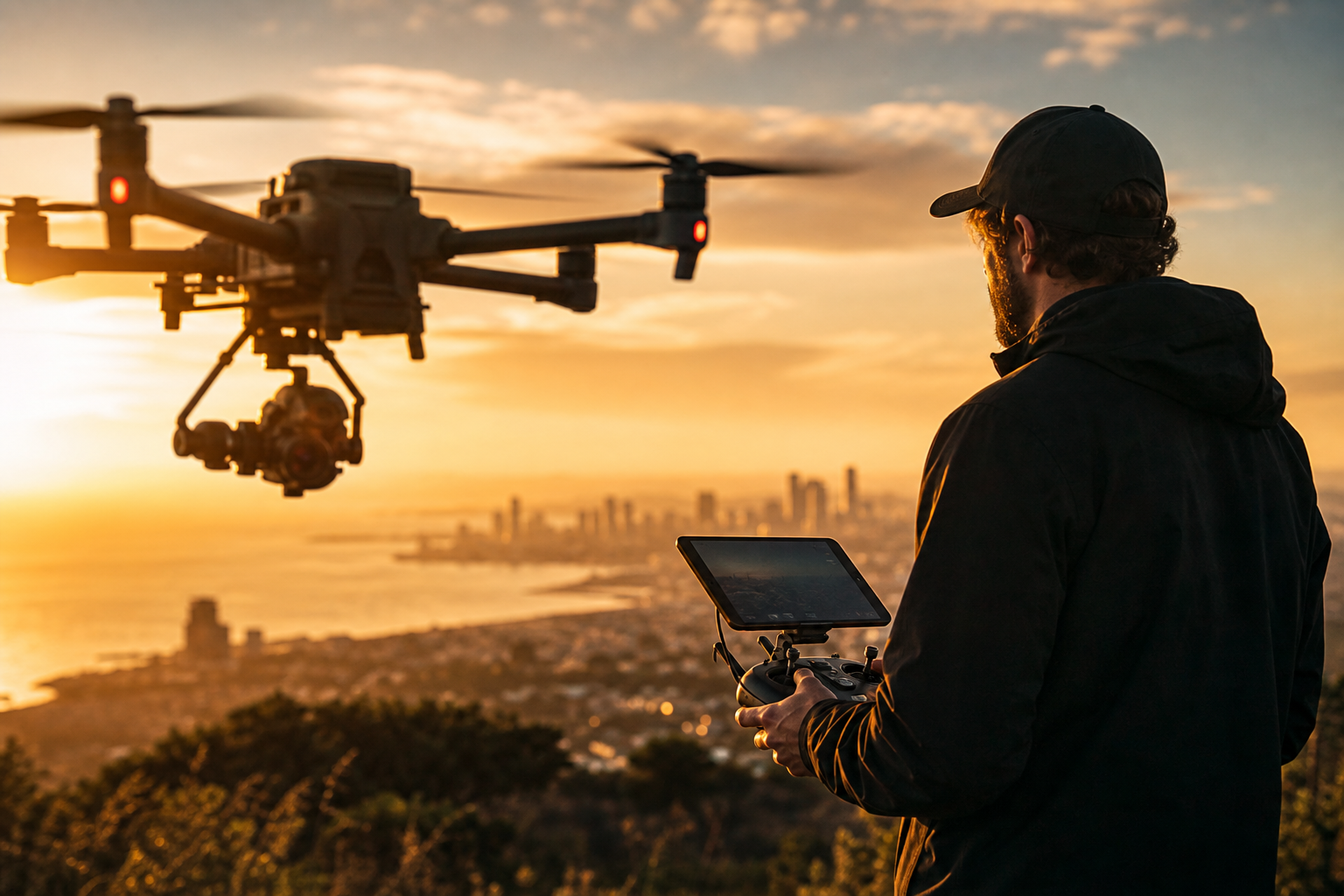
A drone flies where your story can’t. That’s the entire pitch, boiled down — and it’s why drone videography services have reshaped commercial video production from the ground up. Brands that were stuck with tripod shots and rented helicopter hours five years ago are now putting cinematic aerial sequences into every campaign, every property listing, every event highlight reel. The reason is simple: audiences respond to scale, motion, and perspective. Nothing delivers all three at once like a well-flown drone.
The Market Is Taking Off — And It’s Not Slowing Down
If you think drone footage is still a novelty, the numbers say otherwise. The drone filming services market hit USD 378.2 million in 2025 and is projected to reach USD 2.21 billion by 2036, according to Fact.MR. That’s not a niche growing — that’s a category being built in real time.
Growth Market Reports pegs the broader drone cinematography services space at USD 3.8 billion in 2024, forecasting it to hit USD 15.6 billion by 2033 at a 16.2% compound annual growth rate. And according to Emergen Research, the drone photography service market alone was worth USD 4.2 billion in 2024, racing toward USD 14.8 billion by 2034. Drone videography demand specifically rose about 35% in 2024 alone, per FAA data cited by Extreme Aerial Productions.
Here’s what those numbers actually mean: your competitors are already flying. In 2026, skipping aerial footage isn’t saving money — it’s leaving attention on the table.
Saving time, not cutting costs, has become the top reason businesses deploy drones commercially. A global industry whitepaper from Drone Industry Insights shows that improving speed has overtaken both quality improvement and workplace safety as the primary driver. This matters: drone videography isn’t just about pretty shots. It’s about producing those shots faster, more safely, and at a scale that traditional methods can’t touch.
What Separates Professional Drone Footage from the Rest
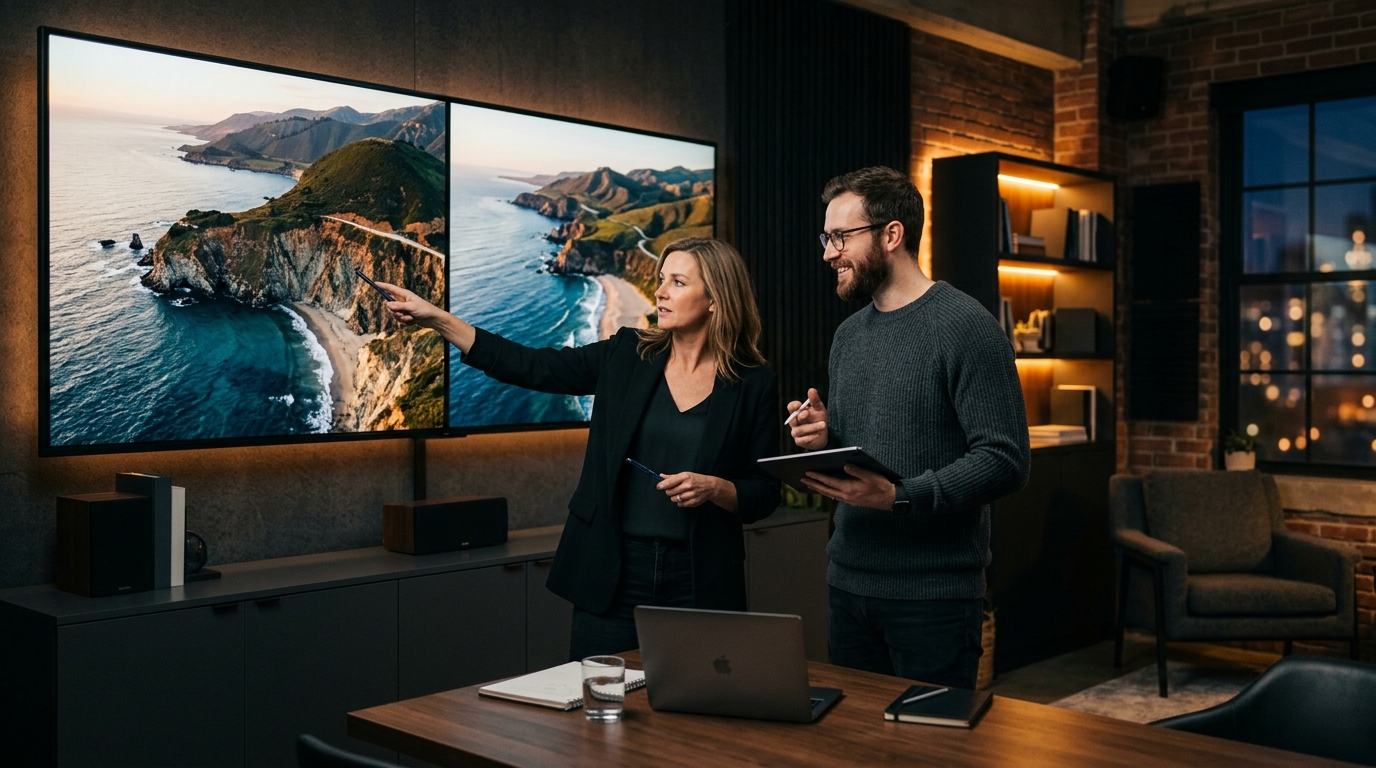
There’s a wide gulf between what a consumer drone captures and what professional drone videography services deliver. The gap isn’t just resolution — though that’s part of it. It’s control, consistency, and knowing what the shot needs before the drone even leaves the ground.
Professionals plan camera moves. They block shots the same way a director blocks a scene. They know how wind, sun angle, and airspace restrictions affect a shoot at 2 PM versus 6 PM. They also edit with intention — not just cutting clips together but grading for mood, stabilizing for polish, and syncing motion to music or voiceover with the precision of a composer.
The Gear Gap Is Real
Pro-grade rigs carry cinema cameras — not the fixed-lens sensor on a consumer drone. We’re talking full-frame 8K capture, interchangeable lenses, adjustable aperture, and the ability to shoot in RAW or LOG formats that give colorists real latitude in post. Drone operators on commercial shoots use dual-operator setups: one pilot flying, one camera operator framing. That division of labor alone changes what’s possible.
Then there’s LiDAR for terrain mapping, RTK GPS for centimeter-precise positioning, and FPV (first-person view) drones for the kind of fast, immersive chase shots that are everywhere in automotive and sports marketing right now. LiDAR lets drones build 3D maps of terrain and structures in real time — critical for surveying, construction documentation, and VFX integration. Consumer gear can’t do any of this. The sensor payload, the lens interchangeability, the flight controller precision — each layer separates professional output from hobbyist footage.
It’s Not Just the Drone — It’s the Team Behind It
A professional drone videography service brings more than equipment. They show up with pre-production planning, location scouting, shot lists, and a creative brief that ties aerial footage to the broader story you’re telling. When you work with a full-service video production team, the drone operator isn’t a one-off hire — they’re integrated into a crew that handles ground cameras, lighting, audio, and post under one roof. The aerial shots don’t look like a separate shoot pasted into the edit. They belong there.
The Technology Stack That Makes Cinematic Drone Footage Possible
Drone videography in 2026 is unrecognizable from five years ago. The camera sensors, the flight stability, the autonomous routing — all of it has matured to the point where a skilled operator can execute shots that used to require a helicopter and a Tyler mount. The difference now is precision.
Modern cinema drones stabilize footage to the pixel. You can fly through a narrow archway at 40 miles per hour and the horizon stays locked. Waypoint programming lets operators pre-map complex flight paths — say, circling a building while maintaining exact distance and altitude — and the drone executes it autonomously. That repeatability matters enormously for commercial work. You can fly the exact same shot for every location in a multi-property real estate campaign. Every building looks consistent. Every brand video shares the same visual language.
FPV drones add an entirely different register. These agile, first-person-perspective rigs fly like racing drones but carry stabilized HD cameras. The footage is immersive, kinetic, and borderline addictive to watch — it’s why automotive brands, sports leagues, and tourism campaigns have gone all-in on FPV over the past two years.
By 2026, commercial drone footage spans everything from roof inspections and facade surveys to cinematic marketing content, as detailed by AirTeam. The tool has matured. The question is whether your brand is using it.
FAA Part 107 and the Compliance Layer Most People Skip
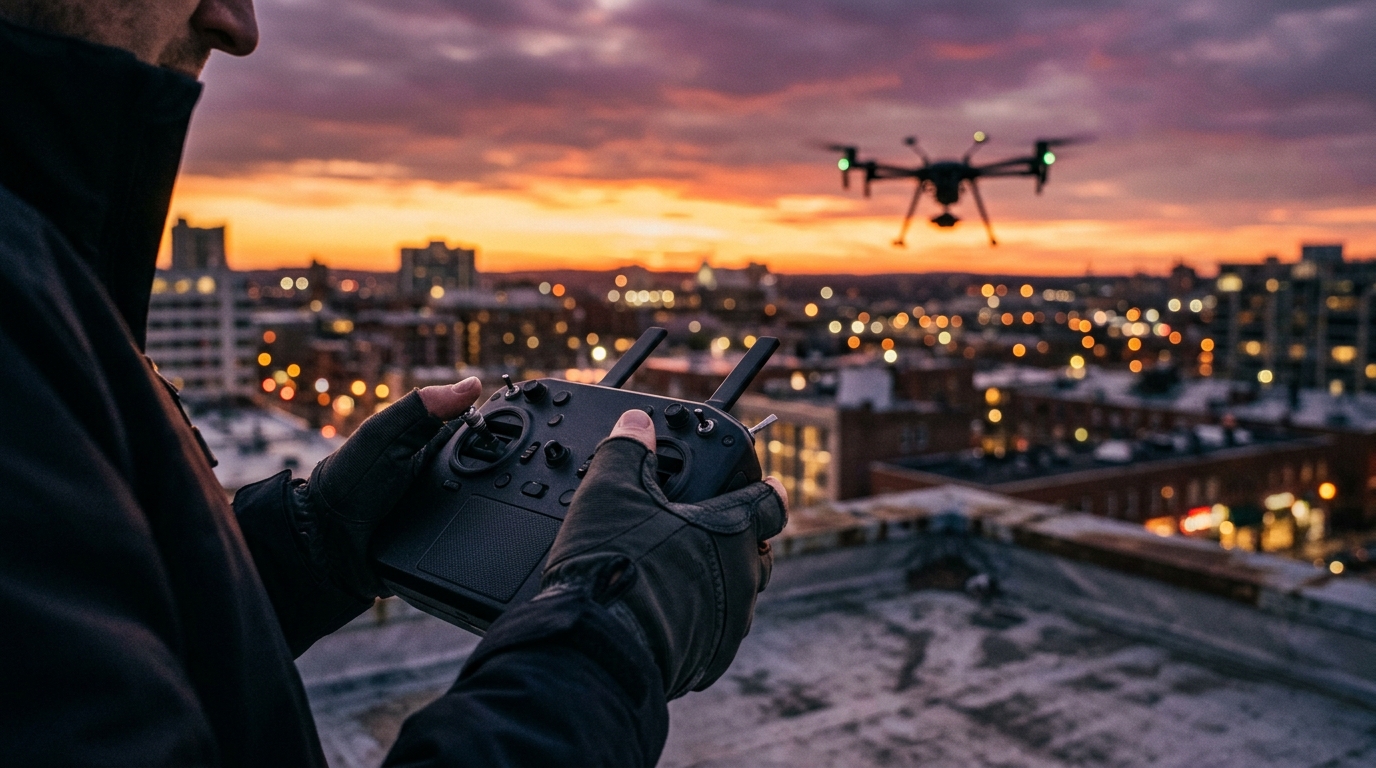
If you’re hiring drone videography services, there’s one acronym you need to know: Part 107. It’s the FAA certification that every commercial drone operator in the United States must hold. No exceptions.
Part 107 isn’t a formality. It requires passing a written aeronautical knowledge exam covering airspace classification, weather patterns, radio communication, emergency procedures, and drone-specific regulations. Operators must renew every 24 months with recurrent training. They need to understand controlled airspace, temporary flight restrictions, and when waivers are required — for flying at night, over people, or beyond visual line of sight.
Why does this matter to you? Because if an unlicensed operator crashes a drone on your shoot, hits a power line, or violates restricted airspace near an airport, the liability doesn’t just land on them. The FAA’s drone regulations cover civil penalties that can reach five figures. And your production insurance likely won’t cover damages from an unlicensed operator’s negligence.
A legitimate drone videography service carries its own aviation liability insurance, files LAANC (Low Altitude Authorization and Notification Capability) authorizations before every flight where required, and arrives on set with a pre-flight checklist that covers airspace, weather, equipment, and emergency procedures. According to The Realty School, Part 107 compliance is the single most overlooked factor in hiring decisions — and the one with the highest potential liability.
How Businesses Are Using Drone Videography to Win
The most effective use of drone videography services isn’t showing off. It’s showing what matters — from an angle no one else can get.
Real estate agents have understood this for years. Aerial footage of a property, especially one with acreage, water frontage, or mountain views, communicates value in seconds that still photos can’t touch. But the use cases have expanded well beyond listings. Hotels and resorts use cinematic fly-throughs to sell the experience of arrival long before a guest books. Construction firms use weekly drone progress videos to update stakeholders and investors without anyone needing to visit the site. Event producers capture scale — thousands of attendees, wide venue shots, stage reveals — in ways that ground cameras simply can’t.
Brand marketing is where drone footage has hit escape velocity. Companies that once commissioned a single hero video per year are now producing aerial content quarterly — for social, for paid ads, for investor decks, for internal culture pieces. The videography industry reached approximately USD 45.2 billion in 2023, with an expected CAGR of 8.1% through 2032, per ZipDo. And 72% of consumers say video helps them make purchasing decisions. Forty-one percent become more likely to buy after watching a video. Those numbers don’t apply to just any video — they apply to video that stops the scroll. Drone footage, almost by definition, does that. An aerial reveal holds attention in a feed. A sweeping orbit over a venue or coastline makes someone pause before scrolling past.
Pretzel Logic Productions has seen this shift firsthand. When a brand partners with a creative team that understands both aerial cinematography and ground production, the result isn’t a drone reel stapled to a regular video. It’s one cohesive narrative — the aerial shots establish scale and setting, ground cameras deliver intimacy and detail, and post-production stitches both together into something that feels like film, not marketing.
For brands already working with a full-service marketing partner like InnoVision Marketing Group, adding professional drone footage to the campaign mix multiplies what’s possible. A brand video that pairs aerial establishing shots with street-level brand storytelling, then distributes both through a coordinated digital campaign, performs differently than one without the aerial dimension. It simply covers more visual ground.
Choosing the Right Drone Videography Partner
Not all drone videography services are built the same. The market is splitting into three tiers: solo operators with a consumer-grade drone and a Part 107 cert, specialized aerial-only firms that fly cinema drones but don’t produce finished content, and full-service video production studios that integrate aerial cinematography into a complete production workflow.
Which tier you need depends entirely on the problem you’re solving. Drone videography services exist across a wide spectrum of quality and capability — and the price spread reflects that range honestly. A wedding videographer with a Part 107 cert isn’t competing with a cinema production studio. Neither is wrong. They’re just built for different outcomes. If you just need B-roll of a single building for an internal report, a solo operator might be fine. If you need aerial footage that will anchor a brand campaign, appear on broadcast television, or define how your company looks to the world for the next three years, the calculus changes.
Here’s what to evaluate:
Portfolio consistency. Look past the highlight reel. Ask for full project files — the footage that didn’t make the montage. How does the operator handle overcast days? Windy conditions? Tight spaces? The gap between a curated reel and real deliverables is where you discover whether a provider actually delivers.
Creative integration. Drone shots shouldn’t feel added. They should feel inevitable — the only way that scene could have been captured. That requires a team that thinks about aerials during pre-production, not as an afterthought grafted onto a ground-only shoot. A production company with post-production capability under the same roof can grade aerial and ground footage in the same session, match motion across camera types, and build sequences where the aerial-to-ground transition is invisible.
Insurance and compliance. Ask for the operator’s Part 107 certificate number, their aviation liability coverage, and their process for filing LAANC authorizations. If any of these are missing or vague, walk. The risks aren’t theoretical — a single airspace violation can shut down a shoot and trigger FAA enforcement.
Storytelling instinct. Flying a drone is a technical skill. Framing a shot that advances a narrative is a creative one. The best aerial cinematographers understand editing rhythm, visual continuity, and how motion through space communicates emotion. A slow, rising reveal says something different from a fast, low pass. Both are “drone shots.” Only one serves your story.
The most reliable path, especially for brands investing in professional video at scale, is to work with a studio where drone videography services sit alongside scriptwriting, direction, audio engineering, and editing. The drone shots don’t land in a vacuum — they need to flow into ground footage without a visible join, match color and motion, and feel like one cohesive film, not a reel with a few aerial clips wedged in. When everything lives under one creative team — pre-production through final delivery — the aerial shots don’t just look good. They work hard. They earn their place in the edit.
Frequently Asked Questions
What is the difference between a drone operator and drone videography services?
A drone operator flies the aircraft. Drone videography services encompass the full creative and technical workflow — pre-production planning, shot design, creative direction, aerial cinematography, ground camera integration, and professional post-production editing and color grading. The operator is one role on a larger team. The service is the complete deliverable.
Do I need FAA Part 107 certification to hire a drone videographer?
You don’t need certification — your operator does. Every commercial drone pilot in the U.S. must hold a current FAA Part 107 Remote Pilot Certificate. Before hiring, verify the operator’s certificate number and confirm they carry aviation liability insurance. A legitimate provider will provide both immediately.
How much does professional drone videography cost?
Costs vary widely based on project scope, location, equipment, crew size, and deliverables. A half-day single-operator shoot differs from a multi-day production with a cinema drone, dual operators, location permits, and full post-production. The best approach: share your project brief and ask for a detailed scope of work rather than a one-size-fits-all quote.
Can drone footage be used in TV commercials and broadcast content?
Yes. Professional drone videography services deliver footage in broadcast-ready formats — typically 4K or 8K in LOG or RAW color profiles — that integrate directly into TV commercial timelines. The key is shooting at frame rates and resolutions that match the broadcast deliverable, which requires cinema-grade equipment and an experienced crew.
What industries benefit most from aerial videography?
Real estate, hospitality, construction, and tourism were early adopters, but drone footage now appears across automotive, sports, healthcare marketing, nonprofit storytelling, and corporate brand campaigns. Any industry where physical scale, location, architecture, or event energy matters to the audience can use aerial cinematography effectively.
Is drone footage safe to fly over people or in urban areas?
The FAA has strict rules about flying over people, moving vehicles, and in controlled airspace. Professional drone videography services handle these restrictions through waivers, LAANC authorizations, and careful pre-flight planning. Urban shoots often require additional coordination — road closures, pedestrian management, and coordination with local authorities — that experienced producers handle as part of the production workflow.
Tell Your Story From Every Angle
Drone videography services have moved from optional to essential for any brand serious about video. The numbers back it up. The technology is ready. The only variable left is execution — who you trust to put a camera in the sky and bring back footage that actually moves people. In a market where drone videography services are projected to grow by over USD 34 billion in the next few years, the gap between good enough and exceptional is only getting wider. Pick the partner who closes that gap.
Pretzel Logic Productions brings the full picture: concept through completion, aerial through ground, cinematography through post. When your story needs altitude — literally and creatively — let’s talk. Your audience is already scrolling. Give them something worth stopping for.