
Corporate video production is the professional process of planning, filming, and editing video content that represents your brand, communicates your message, and drives real business outcomes. Done right, it transforms how audiences perceive your company — and how they decide to work with you. Ready to bring your brand story to life? Start a conversation with Pretzel Logic Productions.
What separates a forgettable corporate video from one that actually moves people to act? It’s not the camera. It’s not the gear. It’s the story — and the team with the craft and creative instincts to tell it right. Corporate video production has become one of the highest-leverage investments a modern business can make, and the brands that understand this are building trust and authority that compounds every year.
This guide covers everything you need: what corporate video production actually involves, why it works, which formats deliver results, and how to find the right partner for the job.
What Is Corporate Video Production?
Corporate video production is the end-to-end process of creating professional video content for business use — from the first strategy conversation through final delivery and distribution. Unlike consumer entertainment or casual social content, corporate video serves a defined business purpose: building brand authority, communicating complex ideas, training employees, attracting investors, or driving conversions.
The term “corporate” misleads people. It doesn’t mean stiff, scripted, or soul-less. The best corporate videos are just as emotionally resonant as any film — because they’re built on the same storytelling principles. They happen to have a boardroom application rather than a cinema screen.
When a professional corporate video production team approaches your project, they’re not just pointing cameras at your office. They’re building a visual argument for why your brand matters — and engineering every frame to make that argument land.
Types of Corporate Videos
Corporate video production spans a wide range of content types, each serving a different function in the business ecosystem:
- Brand story videos — the definitive statement of who you are and why it matters
- Product and service showcases — visual proof that your offering delivers
- Training and internal communications — content that keeps distributed teams aligned and informed
- Client testimonial and case study videos — social proof in its most compelling form
- Event and conference coverage — capturing milestones and extending their reach across channels
- Investor and stakeholder presentations — high-stakes communication at its most polished
- Recruitment videos — showing top talent why your culture is worth choosing
Corporate vs. Commercial Video Production: Understanding the Difference
There’s often confusion between corporate video production and commercial production. A commercial is typically an advertisement designed for broadcast or paid media — a TV spot, a pre-roll ad, a streaming campaign. Corporate video is broader: it includes any video content created for business purposes, whether internal or external, advertising or informational.
In practice, many production companies handle both. A full-service team like Pretzel Logic Productions moves fluidly between brand films, corporate training content, and broadcast commercials — because the craft is the same, even when the screen changes.
Why Corporate Video Production Matters for Your Business
The business case for corporate video production has never been stronger — and the data is unambiguous.
Video Builds Brand Trust — Faster Than Any Other Medium
A well-produced brand video communicates things that text simply cannot: the energy of your team, the quality of your craft, the authentic culture of your organization. Audiences form opinions about a brand in seconds, and video is the richest, fastest medium for shaping that impression.
When a potential client lands on your website and watches a 90-second brand video that captures your story with precision and energy, they don’t just understand your offer — they feel it. That emotional resonance is what moves a prospect from passive interest to active conversation.
The Business Results Speak for Themselves
The metrics around corporate video production are hard to ignore. According to Wyzowl’s State of Video Marketing report, 89% of video marketers say video gives them a good return on investment — a figure that has risen consistently year over year. Meanwhile, HubSpot Research consistently finds that video is the leading format marketers are investing in, ahead of blogs, infographics, and podcasting combined.
For corporate applications specifically, the numbers are equally compelling. According to Forbes, 75% of senior executives watch work-related video content at least once per week — and 59% of them prefer video to text when both formats are available for the same information. This isn’t a marginal preference. It’s a fundamental shift in how business decisions get made.
What this means practically: your prospects are already expecting video. Your executive buyers are already consuming it. The companies investing in professional corporate video production right now are building the trust and authority advantage that compounds over time.
The Corporate Video Production Process
Understanding how corporate video production actually works helps you set realistic expectations, brief your team more effectively, and evaluate the quality of any production partner. The process breaks into three distinct phases — and the quality of each phase determines the quality of the final product.
Pre-Production: Where Great Videos Are Actually Made
Pre-production is the phase that separates teams who consistently deliver on brief from teams who consistently deliver surprises. Before a single camera rolls, a professional corporate video production company works through:
- Discovery and strategy — understanding your goals, audience, and the specific outcomes you need the video to drive
- Concept development — building the creative framework that will carry your message from first frame to last
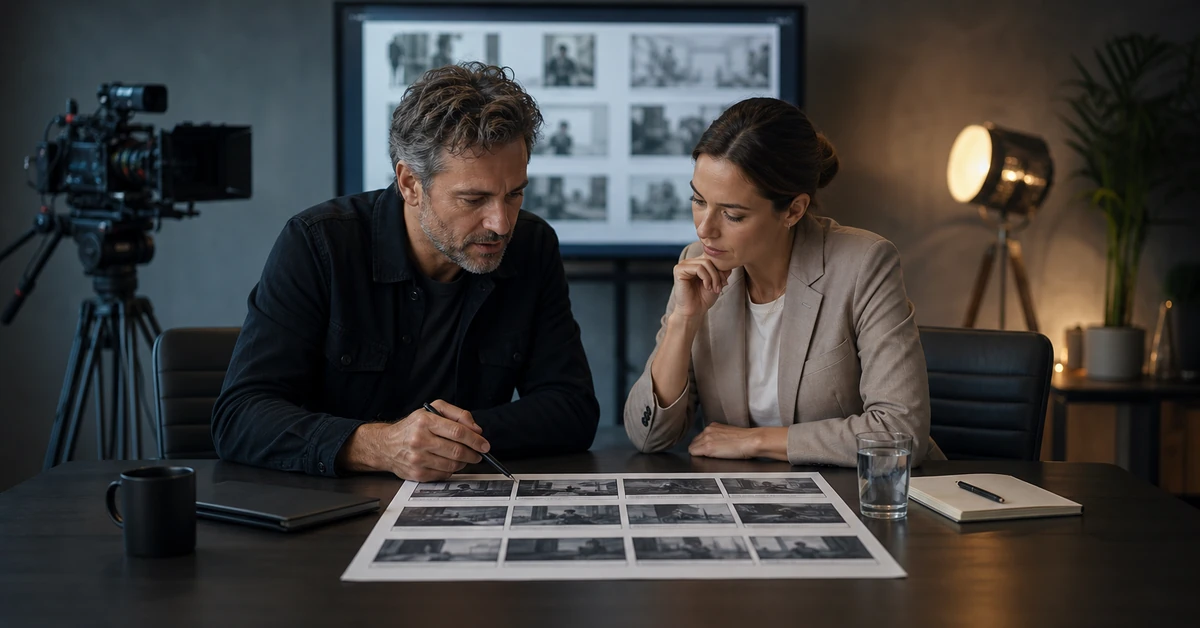
- Scripting and storyboarding — mapping every moment with purpose and precision
- Location scouting — finding environments that reinforce rather than undermine your brand
- Talent coordination — whether that’s professional on-camera talent, subject matter experts, or your own leadership team
- Shot planning and scheduling — ensuring production day runs with zero wasted time and zero missed shots
The quality of pre-production directly determines the quality of the final product. A rushed pre-production phase creates expensive problems on production day and mediocre content in post. Any corporate video production partner worth working with invests serious time here — before they ever pick up a camera.
Production Day: Capturing the Story on Camera
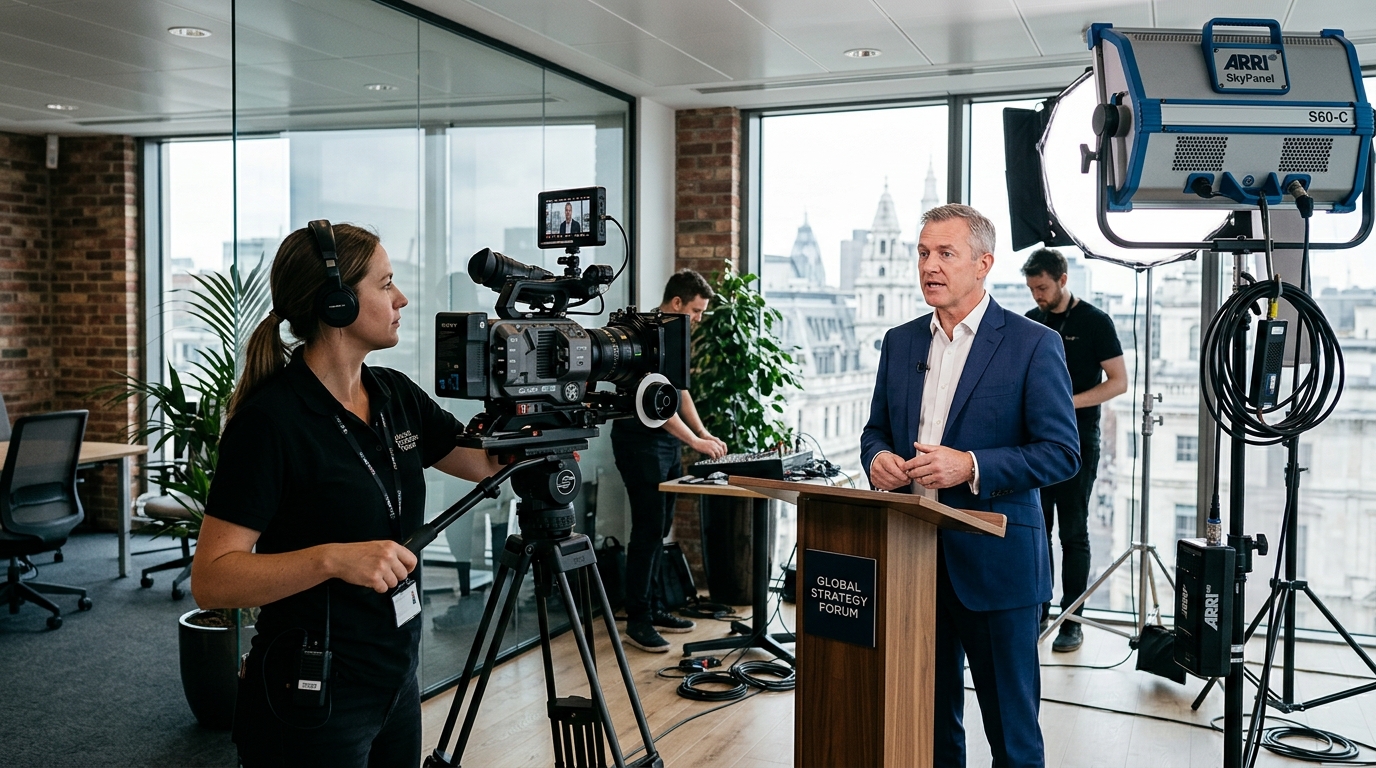
Production day is where preparation becomes performance. With a detailed shot list, confirmed locations, and aligned teams, a professional crew moves with efficiency and creative confidence — capturing everything on brief, on schedule, with the visual integrity the story demands.
This is where the experience of your production team becomes most visible. How do they manage unexpected lighting conditions? How do they direct non-actors — executives, staff members, real clients — to appear natural and authentic on camera? How do they problem-solve in real time when reality differs from the storyboard?
These are the moments that define a great production team. And they’re exactly what separates polished, professional outputs from well-intentioned amateur efforts.
Post-Production: Where Raw Footage Becomes the Story
Post-production is where the raw material transforms into the final product. For corporate video, this phase includes:
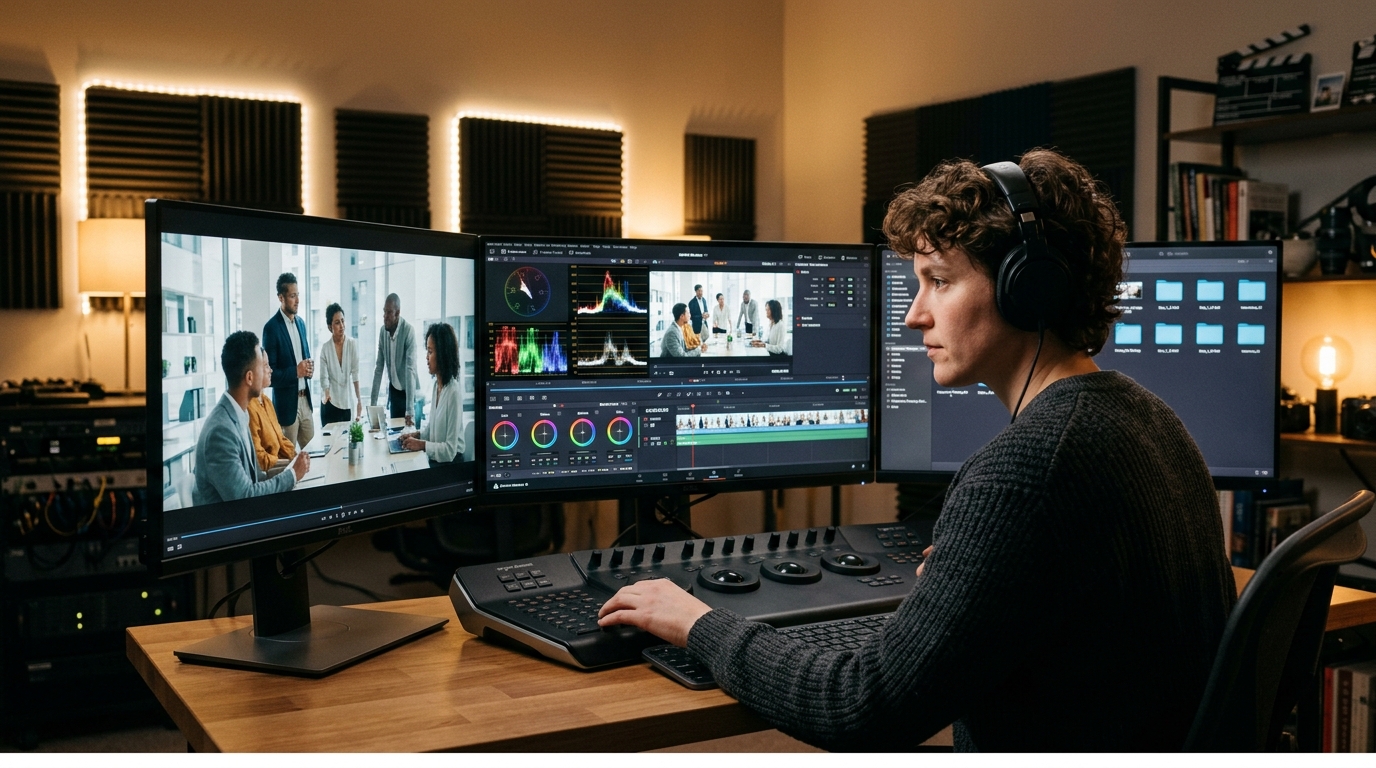
- Video editing — pacing, sequencing, and building the narrative arc
- Color grading — establishing a visual tone that’s consistent with your brand identity
- Sound design and mixing — music selection, voiceover recording, ambient audio, and dialogue clarity
- Motion graphics and animation — titles, lower-thirds, branded elements, and visual transitions
- Revision rounds — incorporating client feedback with precision and without losing the edit’s momentum
Done well, post-production elevates everything that came before it. It isn’t just a finishing step — it’s a storytelling step. The edit tells the story. The shoot is just the raw vocabulary.
What Makes Corporate Video Truly Effective
The most expensive corporate video fails if the story doesn’t connect. And some of the most powerful corporate videos ever made were built on modest resources — because their teams understood what actually moves an audience.
Storytelling Is the Strategy
The most common mistake in corporate video production is leading with the company. Your audience doesn’t care about your founding story, your mission statement, or your industry awards — not yet. They care about what you can do for them, and whether they can trust you to deliver it.
Effective corporate video production leads with the audience’s problem, not the brand’s solution. It creates tension before it resolves. It earns attention before it delivers a message. That’s the storytelling craft — and it’s what turns a corporate video from a marketing expense into a business asset that works around the clock.
Brand Consistency Across Every Frame
Great corporate video doesn’t just tell a story — it tells your story. Every visual choice — the color palette, the pacing, the music selection, the locations, the way your team appears on screen — should reinforce your brand identity with intention.
This is where working with a production partner who genuinely invests in understanding your brand pays off. For businesses connected to the InnoVision Marketing Group ecosystem, where brand strategy and video production are handled by teams that collaborate daily, that alignment happens naturally. For brands working with standalone production companies, it requires deliberate integration of brand guidelines into every production decision — from wardrobe to location to grade.
Corporate Video Formats That Drive Results
Not every corporate video serves the same purpose. The right format should follow the function — and the right format for your next project depends entirely on the specific business goal you’re trying to achieve.
Brand Story and Culture Videos
The brand story video is the crown jewel of corporate video production. It communicates your purpose, personality, and positioning in a format engineered for maximum emotional impact. These videos live on homepages, in sales decks, at trade shows, and in partnership conversations — anywhere you need a prospect or partner to quickly understand and feel what you stand for.
Culture videos serve a similar function internally — and externally as recruiting tools. In competitive hiring markets, a well-produced culture video is often the deciding factor that convinces exceptional talent to choose your team over a larger offer from a less compelling brand.
Training and Internal Communications Videos
Training videos have fundamentally transformed organizational learning. What once required in-person sessions, printed manuals, or hour-long meetings can now live in a well-produced on-demand video that employees can access, pause, rewatch, and reference whenever they need it.
The ROI on corporate training video production is particularly high: reduced onboarding time, improved knowledge retention across distributed teams, and standardized delivery that scales without adding headcount to your training function.
Product and Service Showcase Videos
Product and service videos close the gap between description and demonstration. They show the work in action — the texture, the capability, the real-world context. For B2B companies especially, a well-produced product video does the persuasive work of ten individual sales calls.
These videos perform across every channel: website product pages, sales email sequences, social media, and paid advertising. They’re consistently among the highest-leverage content investments a B2B brand can make.
Event and Conference Coverage
Live event coverage extends the shelf life of moments that would otherwise disappear after the room empties. Conference highlights, keynote captures, award ceremonies, and team retreats — professionally produced event video creates reusable content for marketing, culture building, and PR purposes that generates value long after the event itself.
How to Choose a Corporate Video Production Company
The production partner you choose determines more than the video quality — it determines the entire experience of making it, and whether the final product actually serves your business goals. Here’s what to look for.
Portfolio First — What to Look For
Always start with the portfolio. Look for range and consistency: can they deliver quality across different formats, audiences, and tonal registers? More importantly, do their videos feel like they genuinely understand the brands they’re representing — or do they feel like generic production with client logos swapped in?
The best corporate video production companies bring a distinct creative point of view that elevates every project without overriding the client’s identity. You want a team that brings a perspective — while still putting your story first in every frame.
Partner vs. Vendor: Questions That Reveal the Difference
The questions a production company asks in your first conversation tell you everything about how they work. A vendor asks about deliverables. A partner asks about goals.
Questions a true corporate video production partner asks in the early conversation:
- What’s the primary outcome you need this video to drive?
- Who is watching this — and what do they already believe before they press play?
- Where does this video live in your marketing or sales funnel?
- How does this project connect to your broader brand narrative?
A production company that skips straight to camera specs, delivery formats, and turnaround timelines without asking about outcomes is not thinking strategically about your business. The best corporate video production partners lead with strategy and let the technical execution follow from it — not the other way around.
Look also at how they communicate during the production process. Do they proactively surface creative decisions for your input, or do they disappear after the brief and resurface with a cut? The production process itself is a signal of how the final product will reflect your vision.
Ready to Tell a Story That Actually Drives Results?
Corporate video production isn’t just a marketing tactic — it’s how modern businesses build trust, communicate complexity, and convert attention into action at scale. From brand films that define your positioning to training videos that align your organization to event coverage that extends your reach, the right video — made by the right team — becomes one of the most valuable assets your business will ever create.
At Pretzel Logic Productions, we build corporate video with a single driving goal: to tell your story in a way that connects, convinces, and converts. Our team brings the creative vision, the production craft, and the strategic thinking to ensure that every project we take on earns its place in your business.
Fresh. Hot. Slightly twisted. Exactly what your brand story needs.
Let’s talk about your corporate video project — and build something that works.
Frequently Asked Questions About Corporate Video Production
How long does a corporate video production project typically take?
A well-managed corporate video production project from brief to final delivery typically takes four to eight weeks, depending on complexity. Simple interview-style videos or internal communications pieces can move faster. Brand story films and multi-location productions require more pre-production time to execute properly. Rushing the timeline — particularly the pre-production phase — is the most common cause of disappointing results. A production partner who pushes back on an unrealistic timeline is usually the one worth hiring.
What should I prepare before meeting with a corporate video production company?
Come to your first conversation with a clear sense of the business outcome you need the video to drive, a rough idea of your audience, and any brand guidelines you have available. You do not need a fully formed script or creative concept — that is part of what the production partner develops with you. The clearer you are on the goal and the audience, the faster the creative process moves and the sharper the final product will be.
How do I measure ROI from corporate video production?
Define your measurement framework before production begins, not after. Depending on the video format and where it lives in your funnel, ROI metrics might include website conversion rates on pages where the video is embedded, time-on-page improvements, sales cycle length for prospects who viewed the video versus those who did not, employee retention metrics for culture and recruitment videos, or training completion and knowledge retention scores for internal learning content. The clearest ROI stories come from brands that decided what success looks like before the first camera rolled.