
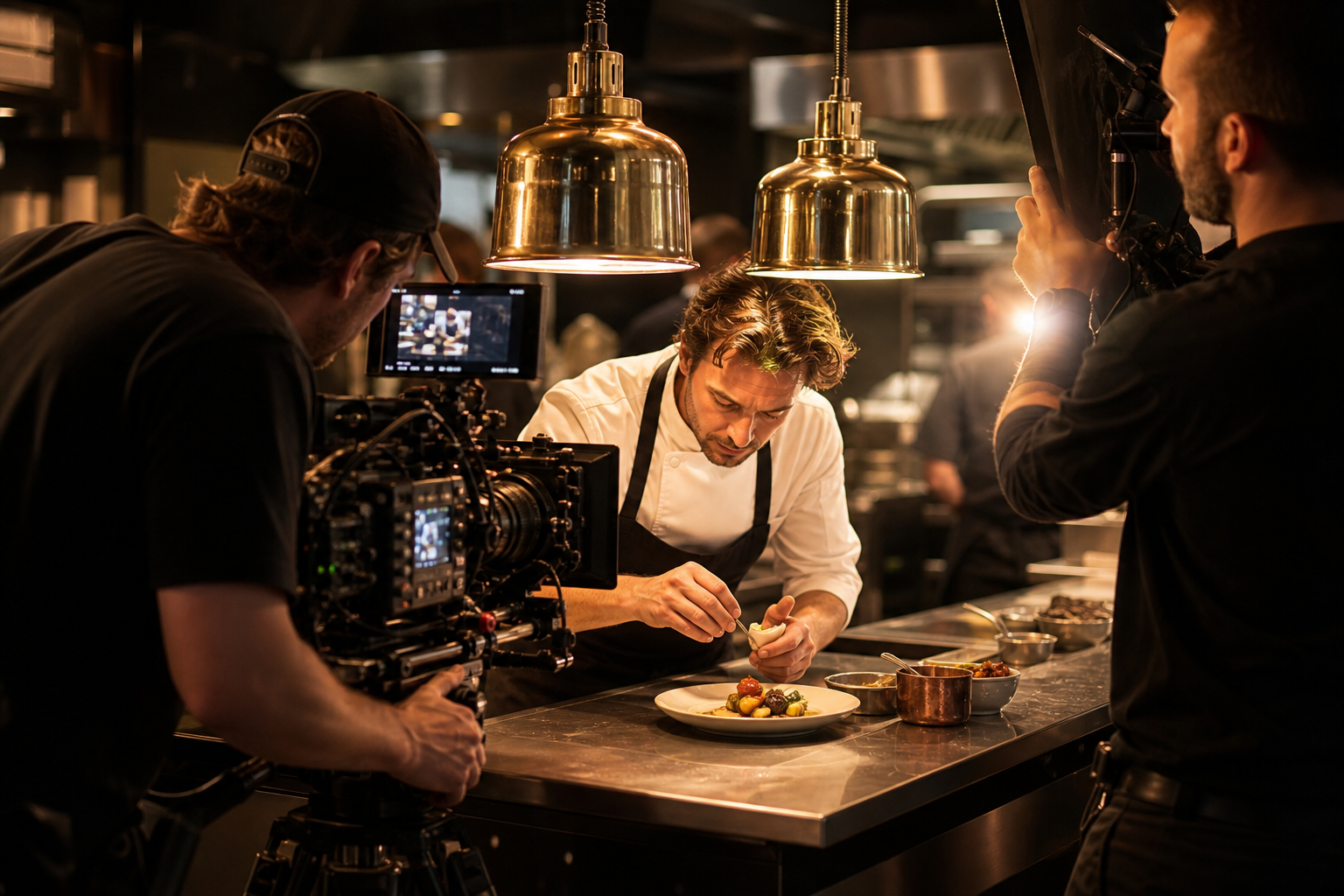
Every reservation starts with a decision. And in 2026, that decision happens on a screen before it ever happens at a table. 85% of diners check a restaurant’s social media before visiting. They’re not reading menus. They’re watching. That’s why restaurant video production has shifted from a luxury line item to a fundamental pillar of how modern food and beverage brands compete.
The restaurants filling seats on Tuesday nights aren’t doing it on word of mouth alone. They’re doing it with video that stops the scroll, stirs appetite, and plants a location in someone’s memory long before they ever feel hungry. This guide breaks down exactly why professional restaurant video production works, what it looks like when it’s done right, and how to build a content strategy around a single production investment that pays back in foot traffic, online orders, and loyal regulars.
Why Restaurant Video Production Has Become Non-Negotiable
The restaurant industry has always been visual. Food photography has been a marketing staple for decades. But static images don’t move. They don’t sizzle. They don’t show the controlled chaos of a line cook at peak service or the chemistry between a bartender and their regulars. Video does.
And the audience has made their preference clear.
The Statistics That Tell the Story
According to Restaurant Velocity’s 2026 video marketing playbook, video marketing drives 83% more sales for restaurants compared to brands that rely on photography alone. TikTok users have a 55% likelihood of visiting a restaurant after seeing menu content on the platform. That’s not engagement. That’s a reservation waiting to happen.
The shift is also playing out in advertising budgets. NBCUniversal’s Restaurant 2024 Year in Review found that short-form video advertising spend among restaurant brands grew 47% year-over-year in 2024, now accounting for 21% of total digital restaurant ad spend. Restaurant operators who moved early into video are already seeing the returns. The ones who waited are playing catch-up.
Then there’s search behavior. Research from Masterestaurant shows that “food near me” searches grew 99% year-over-year in 2025. People are looking. Video is the content format that answers that search with something visceral — atmosphere, personality, and an appetite-triggering preview of what’s waiting.
Video vs. Static Photography: What the Data Shows
Restaurant listings with video receive 40% more clicks than listings with photos only, according to Ananas Video Studio’s 2026 guide. That click gap is a revenue gap. If two restaurants are side by side on a review platform or Google Maps and one has a compelling video loop while the other has three static photos, the math is straightforward.
Video also shows what photography can’t. A beautifully lit dish is one thing. But seeing a skilled chef torch a crème brûlée tableside, or watching the steam rise off a bowl of broth in the middle of a warm, full dining room — that’s the experience. Restaurant video production doesn’t just show food. It sells an evening.
The 5 Essential Types of Restaurant Video Production
Not all restaurant video is the same. A well-built content library draws from multiple formats, each serving a different purpose in the guest’s decision journey. Here’s a breakdown of what matters and why.
Brand Story Films
These are the anchor assets. The 60–90 second film that lives on your website’s homepage and tells the story of who you are — not just what you serve. Where you came from, what drives you, what you believe about hospitality. A great brand story film positions a restaurant as a destination with personality, not just a place to eat. For restaurant groups and concepts with strong founding stories, this is often the highest-leverage video investment you can make.
Menu and Food Showcase Videos
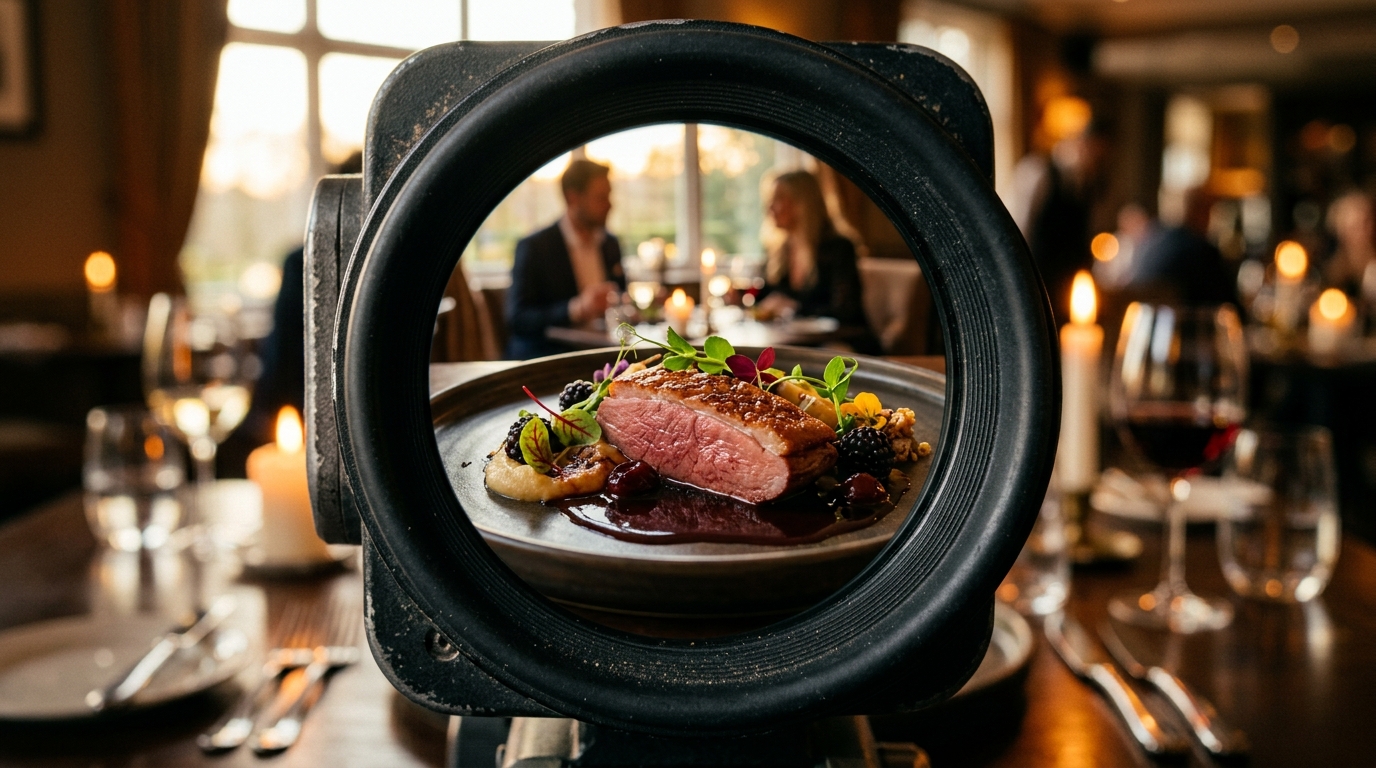
Close-up, beautifully lit shots of hero dishes. The crunch of a crust. The pour of a sauce. A perfectly seared piece of fish landed on a plate with precision. These videos live on social media feeds, on delivery platform listings, and on menu pages. They exist to make viewers hungry. Done with a professional cinematographer’s eye for light, texture, and motion, a 15-second food video can generate more appetite than a full-page feature in a print magazine.
According to Back of House’s professional videographer guide, the difference between phone-shot content and professional food video isn’t just equipment — it’s storytelling. A professional brings compositional instinct and emotional intelligence to every shot that produces a response in the viewer, not just documentation of a dish.
Behind-the-Scenes Kitchen and Culture Content
Transparency builds trust. Showing the kitchen in motion — the prep work, the team dynamic, the care that goes into service — humanizes a restaurant brand in a way that polished promotional content alone can’t. Behind-the-scenes clips boost restaurant social media engagement by up to 40% compared to standard menu photography, per Restaurant Velocity’s research. Guests want to know who’s cooking their food. Video is the fastest way to introduce them.
Social Media Reels and Short-Form Content
Short-form video is the dominant discovery format for food and beverage brands right now. Gitnux’s 2026 culinary industry statistics show that 40% of consumers prefer to watch short-form video under 60 seconds for product discovery — making it the single most effective format for getting a new restaurant in front of new eyes. The challenge is consistency. A single-day production shoot can generate 20–40 cut-down clips from longer master footage, creating a content bank that covers weeks of social posting.
TV and Digital Advertising Spots
For restaurant groups, chains, and concepts running paid media, professionally produced TV commercials and digital ad spots are still among the highest-converting formats available. These require scripting, casting, location control, and post-production craft — the full weight of a professional production. When Pretzel Logic Productions produced a fully AI-powered television commercial for Valley View Casino & Hotel that aired across San Diego during the Super Bowl in early 2026, it demonstrated what production at that level can accomplish for a hospitality brand. The same creative ambition and technical execution applies to restaurant advertising at scale.
How Professional Restaurant Video Production Differs From DIY Phone Content
Let’s address the obvious question directly: doesn’t everyone have a camera in their pocket? Yes. And some phone-shot restaurant content absolutely works for certain uses. Authentic, unpolished moments have real value in the mix. But professional restaurant video production isn’t in competition with your phone — it’s doing something entirely different.
The Visual Credibility Gap
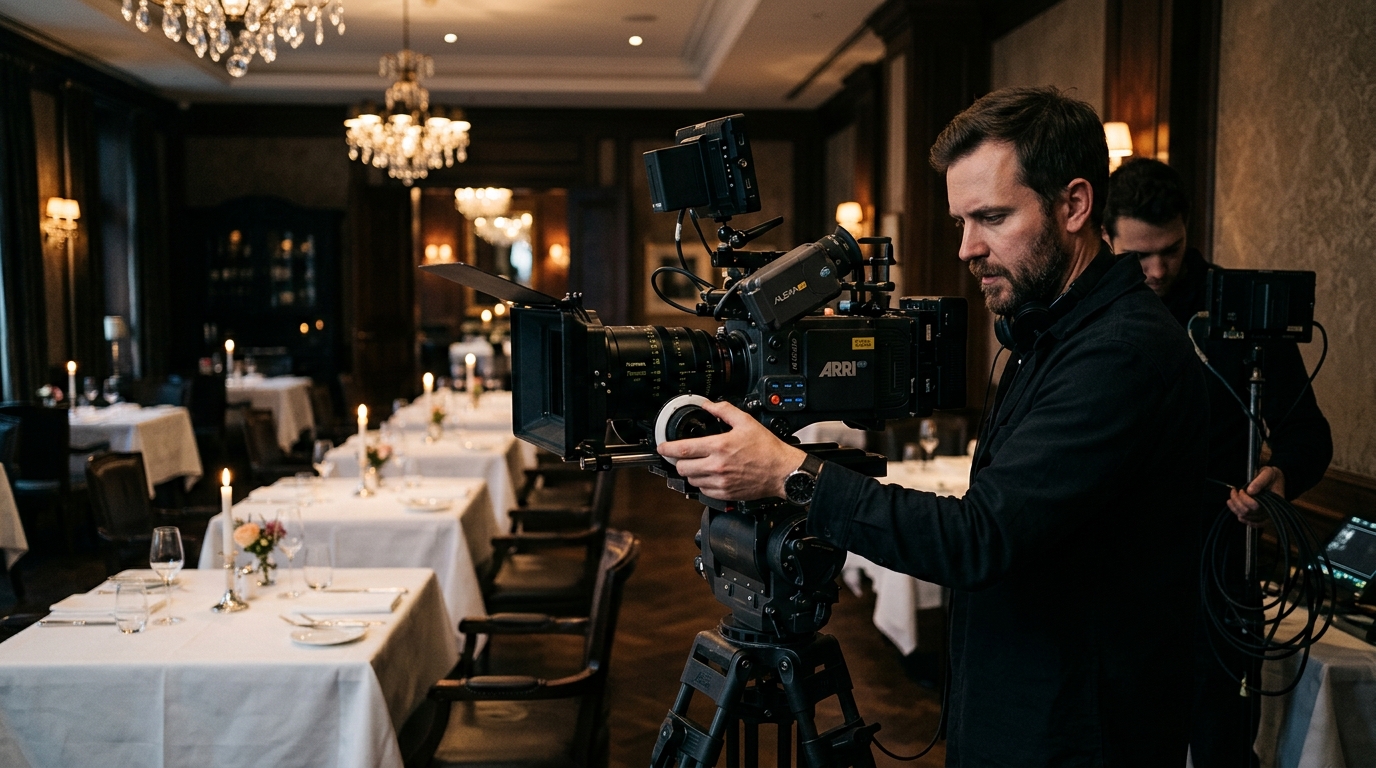
There’s a reason luxury hotels don’t use iPhone photos in their booking campaigns. Visual quality signals something to the viewer — about the level of the experience, the intentionality behind the brand, and the care taken in every detail. Restaurant video production at a professional level communicates the same thing. Shallow depth of field that separates a dish from a beautifully blurred dining room background. Controlled lighting that makes a sauce look like a painting. Sound design that makes the sizzle of a pan feel cinematic. These aren’t tricks. They’re the craft of storytelling through a camera, applied to food and hospitality.
Guests who haven’t visited your restaurant are evaluating you entirely on what they see. If your visual content looks like it was shot on a lunch break, that’s the impression you’re leaving. Professional restaurant video production raises that impression — and first impressions determine whether someone makes a reservation or keeps scrolling.
What a Professional Production Team Actually Delivers
Beyond the camera, a professional production team brings a director with a creative vision for your story, a director of photography who understands light and movement, sound engineers, food stylists who know how to make dishes look their best on camera, and a post-production team who color-grades and edits with intention. That’s a full creative unit working in your restaurant for a production day — and the output isn’t a single clip. It’s a library.
The team at Pretzel Logic Productions works exactly this way: client-centric, storytelling-first, and engineered to produce multiple assets from a single shoot. See the portfolio of completed work to understand what that production philosophy looks like across different industries, including food and beverage clients.
From One Production Day to a Full Content Library
One of the most persistent myths about professional restaurant video production is that it’s a one-and-done expense that produces a single deliverable. It’s not. A well-planned production day is a content machine.
The Multi-Format Content Model
Here’s what a thoughtfully structured restaurant production day can yield:
- 1 brand story film (60–90 seconds) — for website homepage, booking platforms, and presentations
- 2–3 hero dish showcase videos (15–30 seconds each) — for Instagram reels, TikTok, and Google Business profile
- 1 behind-the-scenes culture cut (30–60 seconds) — for social media and recruiting
- Multiple still frames extracted from footage — for social posts, print, and website imagery
- 20–40 short-form clips cut from longer master footage — for weeks of social content
- Raw footage that can be repurposed into future edits as your story evolves
That’s not one piece of content. That’s a quarter’s worth of marketing assets generated in a single coordinated effort.
Why This Approach Wins
The math is simple. When production is fragmented — a phone video here, a hired freelancer there, a quick clip from a staff member — the output lacks visual coherence. The brand feels inconsistent across channels. Professional restaurant video production solves that by creating assets that are visually cohesive, strategically planned, and built to perform across every channel simultaneously. The restaurant brand looks the same on Instagram as it does on the website as it does in a paid ad — because everything came from the same creative session, guided by the same vision.
For restaurant groups managing multiple locations or concepts, this consistency is even more critical. Every market-facing touchpoint reinforces the same identity. That’s brand building, not just content creation.
The ROI of Restaurant Video: What the Data Actually Says
ROI in restaurant marketing isn’t always measured in spreadsheets. But there is a clear body of data showing that video investment pays back.
Foot Traffic, Click-Through Rates, and Conversion
According to Google Consumer Surveys cited by VID, 41% of restaurant-goers use online reviews and videos to decide where they want to eat. Video isn’t a top-of-funnel awareness play — it’s influencing the actual conversion decision. That places it closer to a reservation system than a marketing luxury.
On the advertising side, Wyzowl’s 2026 Video Marketing Statistics — tracking 12 consecutive years of data — report that 91% of businesses now use video as a marketing tool. 82% of marketers say video has given them a good ROI. These numbers reflect a market that has moved well past experimentation. Video is the expected standard. Restaurants still operating without it are competing with one hand behind their back.
For location-specific restaurant brands, the local search dimension amplifies everything. “Food near me” searches grew 99% year-over-year. Video content that’s properly tagged and posted to Google Business Profile, Instagram, and TikTok becomes a discovery engine — appearing in those searches with a visual hook that drives the click.
What to Look for in a Restaurant Video Production Partner
Not every production company is the right fit for every restaurant. The production team you choose for a fine dining concept in a historic building needs different sensibilities than the team shooting a fast-casual brand campaign. Here’s what to evaluate before committing.
Key Questions to Ask Before You Sign Anything
Have they shot food before? Food cinematography is a discipline. Light behaves differently around steam, moisture, and organic textures. A production team with food and beverage experience knows how to handle it. Ask to see their food and restaurant work specifically.
What’s their storytelling process? Great restaurant video production starts with questions before it starts with cameras. A strong production partner wants to understand your founding story, your team culture, your regulars, your signature dishes — and then finds the cinematic angle that makes all of it land on screen. If the first conversation is purely logistical, that’s a signal.
How do they handle post-production? Shooting is half the work. Color grading, audio mixing, pacing, and editing all determine whether footage becomes a compelling video or an afterthought. Ask about their in-house post-production capabilities and see finalized work — not just raw footage.
Can they deliver a content library, not just a single deliverable? A production day that generates one video is a missed opportunity. Ask about their multi-format delivery approach and whether they can produce assets at different lengths and orientations for different platforms.
Pretzel Logic Productions approaches every client engagement with a client-first philosophy — taking each brand on as their own, developing creative concepts that reflect the restaurant’s specific identity rather than applying a template. For restaurants in the food and beverage vertical, that approach is the difference between content that converts and content that gets scrolled past. Learn more about pre-production planning or reach out directly to discuss your project.
Frequently Asked Questions About Restaurant Video Production
How long does a restaurant video production shoot typically take?
Most restaurant video shoots run one full production day, typically 8–10 hours on location. A well-planned production day can yield a brand story film, multiple food showcase videos, behind-the-scenes content, and enough footage to produce 20–40 short-form social clips. Some restaurant groups schedule two-day shoots to capture multiple dayparts — breakfast service, dinner rush, and weekend brunch — each of which shows a distinct side of the restaurant’s personality and energy.
What types of restaurant videos perform best on social media?
Short-form content under 60 seconds consistently outperforms longer formats on TikTok and Instagram Reels. Food process videos — showing a dish being prepared from ingredient to plated presentation — generate high engagement. Behind-the-scenes content showing kitchen culture and team personality also performs exceptionally well. Data from Restaurant Velocity shows TikTok users are 55% more likely to visit a restaurant after seeing menu content on the platform, making food-focused short-form video the highest-converting format for social restaurant marketing.
Is professional restaurant video production worth it for smaller restaurant concepts?
Yes — and the math often works better for independent concepts than it does for large chains. A professionally produced brand story film gives a single-location restaurant the same visual credibility as a regional chain. It signals quality, care, and permanence. For emerging concepts building a reputation, high-production-value video is one of the fastest ways to close the perception gap between where you are and where you want to be seen. A single well-executed production day can yield a year’s worth of marquee marketing assets.
What’s the difference between restaurant video production and food photography?
Photography captures a moment. Video captures an experience. A food photograph shows a dish; a food video shows the pour, the steam, the sear, the presentation — the sensory theater of the dish arriving. For restaurants competing in a visually saturated market, video adds the dimension of time and motion that photography fundamentally cannot. Both have their place in a complete marketing toolkit, but video is the format that converts discovery into decision-making for today’s diner.
How do restaurants use video content beyond social media?
Professional restaurant video production assets live across every marketing touchpoint: website homepage hero video, Google Business Profile video, delivery platform listings, paid advertising on Meta and Google, OTT and streaming TV spots, pitch decks for franchise and investor conversations, recruiting content for chef and service staff hiring, and press kits for media coverage. A single well-executed production generates assets for all of these simultaneously — the channel strategy determines where each version goes, but the creative investment only happens once.
How do I find the right restaurant video production company?
Start with their food and beverage portfolio. Look for evidence they understand the visual language of hospitality — not just technical competence, but an eye for the storytelling that makes food feel alive on screen. Ask about their pre-production process, their multi-format delivery capability, and how they approach the creative brief. The right production partner acts less like a vendor and more like a creative collaborator who genuinely invests in your story. That partnership quality matters as much as the equipment list.
Ready to Tell Your Restaurant’s Story?
The dining room you’ve built, the team you’ve trained, the dishes you’ve perfected — none of that lands on screen by accident. It takes a production team that can read the room, find the shot, and shape raw footage into something that makes a viewer pull up a reservation app. That’s the work.
Pretzel Logic Productions has built a portfolio across the food and beverage industry — from fast-casual to fine dining — bringing the same storytelling-first philosophy to every production, regardless of scale. If you’re ready to build a video library that converts browsers into guests and guests into regulars, the conversation starts here.